

Mai Ndombe Rainforest: DR Congo
Discover how Evertreen helps protect 248,956 hectares of Congo Basin rainforest from commercial logging, supporting 108,000 people and the bonobos and forest elephants that call this forest home.
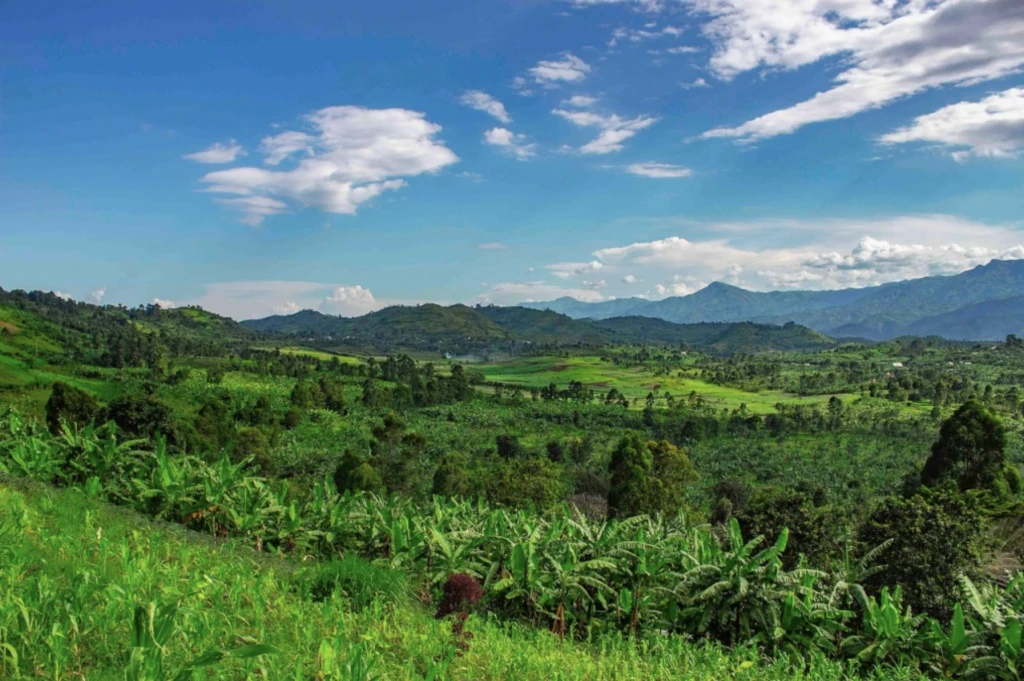 The Mai Ndombe REDD+ Project
Mai Ndombe Province, western Democratic Republic of Congo
Protecting 248,956 hectares of intact Congo Basin rainforest from planned commercial logging. Safeguarding one of the world's largest carbon sinks. Supporting the communities who have lived in and depended on this forest for generations.
Protect a tree in the Democratic Republic of Congo and support this project through Evertreen.
At a Glance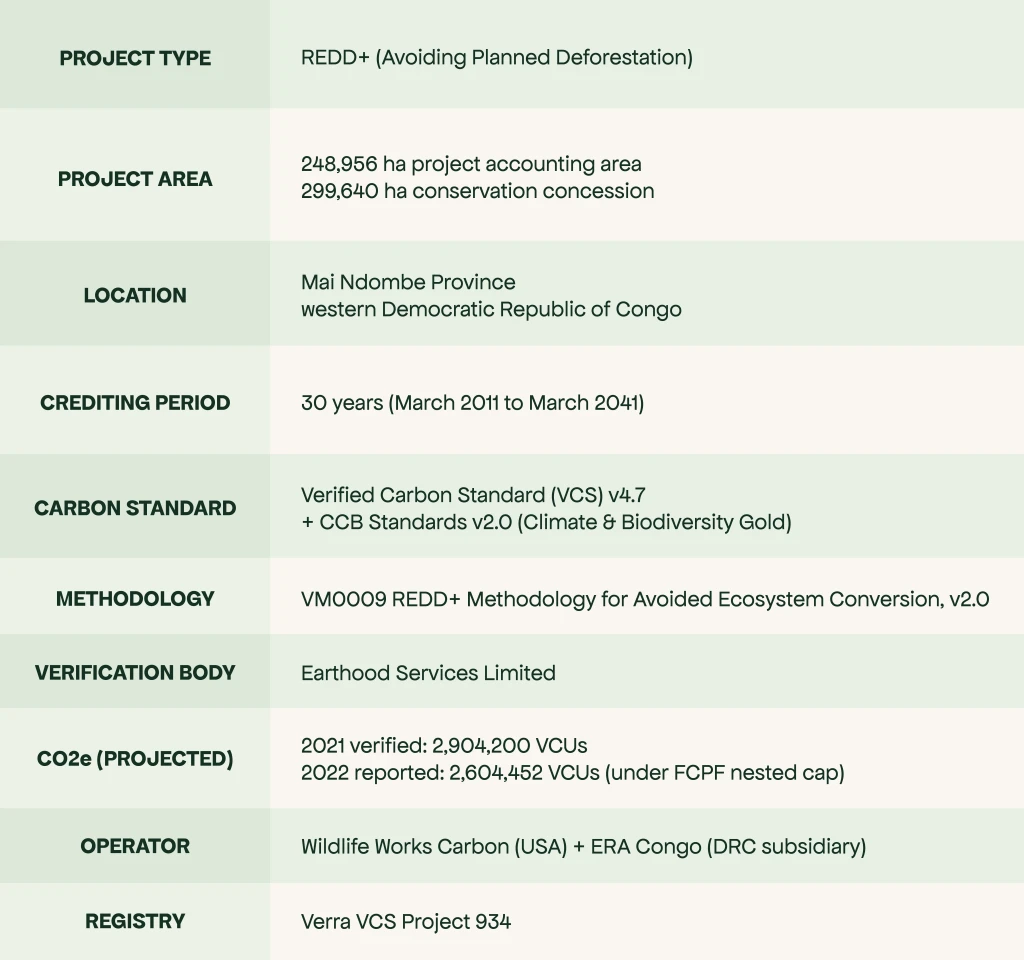
The Mai Ndombe REDD+ Project at a glance:
Project type: REDD+ (Avoiding Planned Deforestation)
Project area: 248,956 hectares project accounting area, inside a 299,640-hectare conservation concession
Location: Mai Ndombe Province, western Democratic Republic of Congo, on the western shore of Lake Mai Ndombe
Crediting period: 30 years, March 2011 to March 2041
Carbon standard: Verra VCS v4.7
Methodology: VM0009 REDD+ Methodology for Avoided Ecosystem Conversion, v2.0
Co-certification: CCB Standards v2.0, Climate and Biodiversity Gold Level
Verification body: Earthood Services Limited
CO2e: 2,904,200 VCUs verified for the 2021 vintage; 2,604,452 VCUs reported for 2022 under the World Bank FCPF nested baseline cap
Operator: Wildlife Works Carbon, with in-country implementation by ERA Congo
Registry: Verra VCS Project 934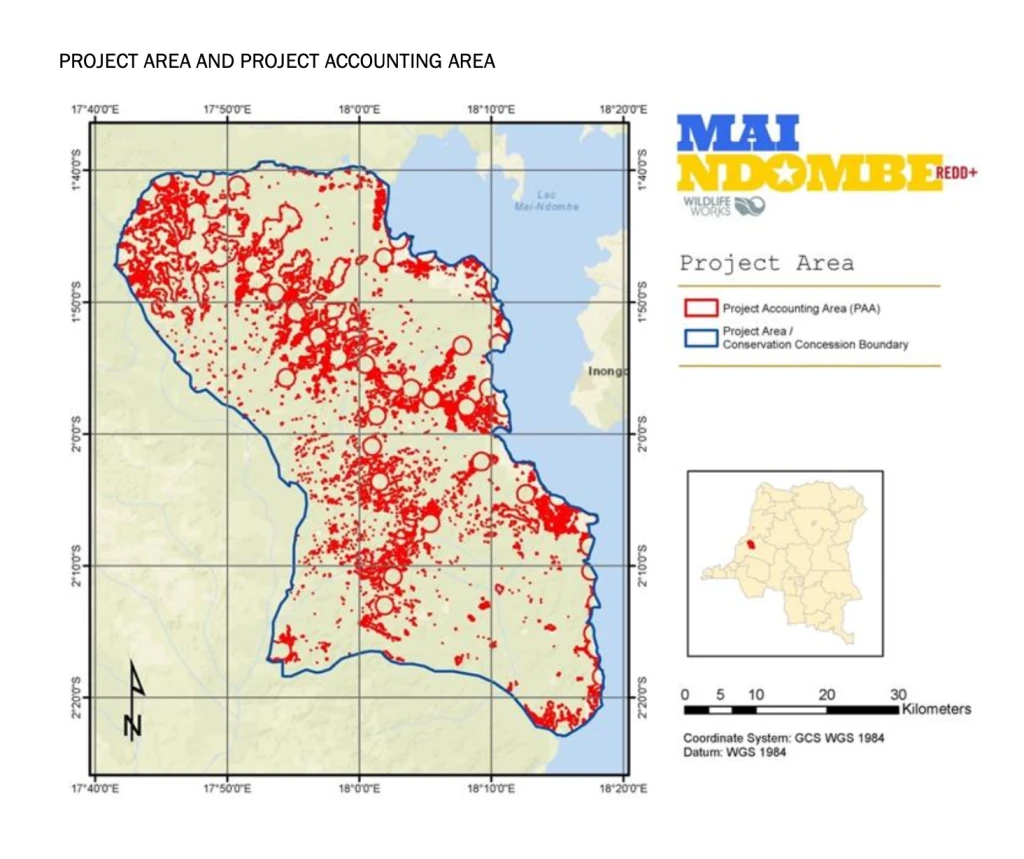
The map shows the 248,956-hectare Project Accounting Area (red boundary) inside the 299,640-hectare Mai Ndombe conservation concession (blue boundary), on the western shore of Lake Mai Ndombe in Inongo Territory.
What This Forest Is Up Against
The bonobo lives in only one place on Earth: the rainforests south of the Congo River, in the Democratic Republic of Congo. The Mai Ndombe REDD+ Project sits inside that range, deep in the Congo Basin, the second largest intact rainforest system on the planet. Before the project began, this forest was earmarked for industrial logging. The two former timber concessions inside the project area hold over 3.5 million cubic metres of commercial hardwood, the kind highly sought by global timber markets. Logging would have come first. Slash-and-burn agriculture and charcoal production would have followed.
The project's baseline modelling, calculated under the Verra-approved VM0009 methodology, estimates that without protection more than 63 million tonnes of CO2 equivalent would have been released across the project lifetime to date. The project takes commercial logging off the table. It then addresses the slower human pressures that drive deforestation: subsistence farming, charcoal use, and a shortage of alternatives. The forest stays standing.
More than 108,000 people live in and around the project area, most of them along the shores of Lake Mai Ndombe. The same forest that stores carbon also provides their food, their water, their medicines, and their cultural sites. The project's design ties forest protection to community development, on the principle that one cannot last without the other.
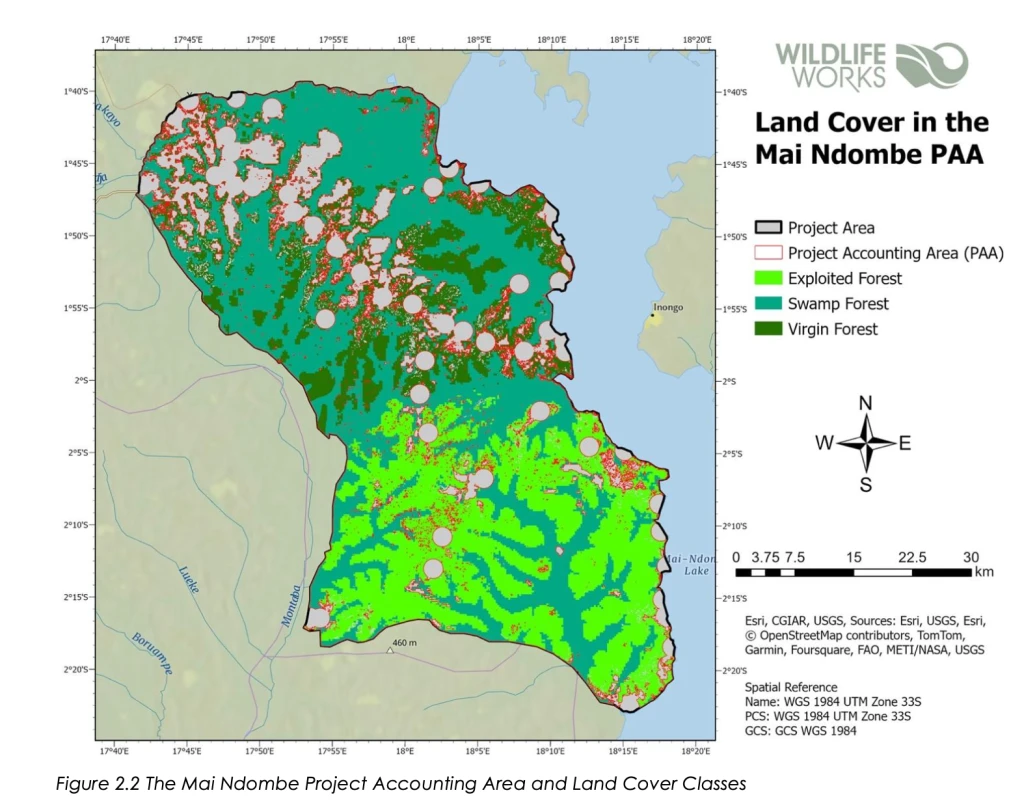 Land cover inside the project accounting area: Swamp Forest (teal), Virgin Forest (dark green), and Exploited Forest (light green). Three habitat types, each with different carbon density and biodiversity value, all under one conservation regime. Source: Mai Ndombe REDD+ Project Monitoring Report, Figure 2.2.
What the Project Does
The project operates under a Carbon Rights Agreement signed with the Government of the DRC in March 2011, granting Wildlife Works Carbon management rights over a 299,640-hectare conservation concession. When you protect trees in the Democratic Republic of Congo through Evertreen, your contribution supports three areas of work:
Forest Protection and Wildlife Monitoring
Inside the 248,956-hectare project accounting area, commercial logging is prohibited. Eco-guards employed and trained by the project monitor the forest. Thirty permanent biodiversity transects run across five forest strata, walked each year by a dedicated monitoring team. In 2022, the team covered more than 70 kilometres on foot, recorded over 1,000 wildlife encounters, and confirmed seven IUCN-threatened species inside the project area.
Community Health, Education, and Water
In 2022 alone, the project completed five new schools, drilled or repaired 21 water wells serving more than 27,000 people, and deployed five mobile clinics. When an Mpox outbreak hit 20 villages inside the concession, the project mobilised and paid 11 doctors and 81 nurses; the project reports that 1,211 of 1,268 cases identified were cured. Eight Local Development Committees were elected and trained during the year, totalling 120 members, giving communities formal authority over how project activities are designed and where they happen.
Sustainable Agriculture and Food Security
Slash-and-burn agriculture is one of the main drivers of forest loss in the region. The project addresses this through agriculture villages, demonstration gardens, improved cassava varieties, and fishponds stocked with Nile tilapia and catfish. By the end of 2022, two agriculture villages were operating, 26 demonstration gardens were active, and the project reports that 51 percent of households had adopted new farming methods.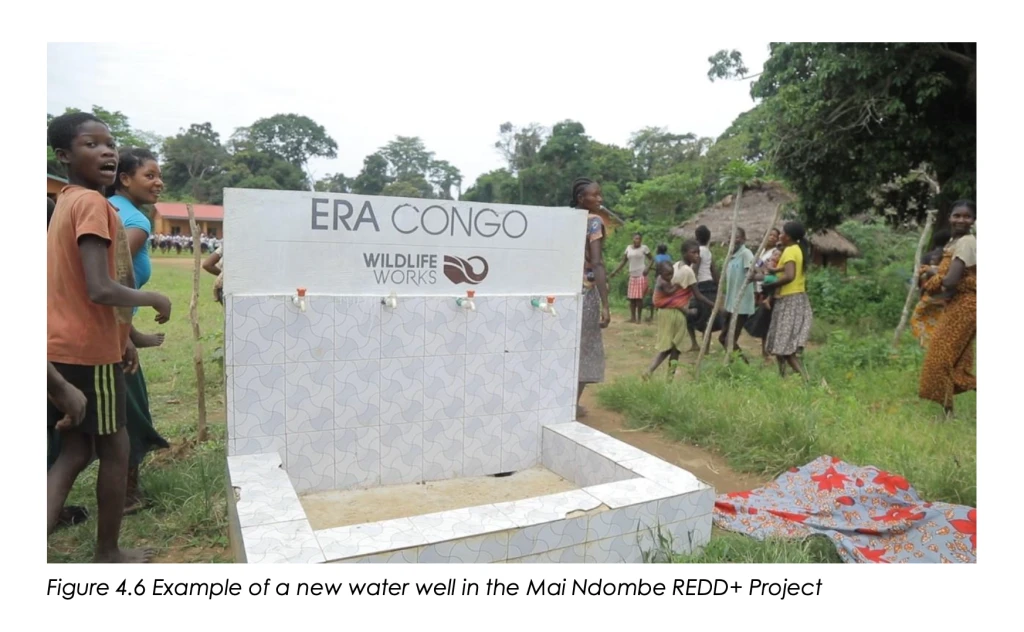
Real Numbers, Real People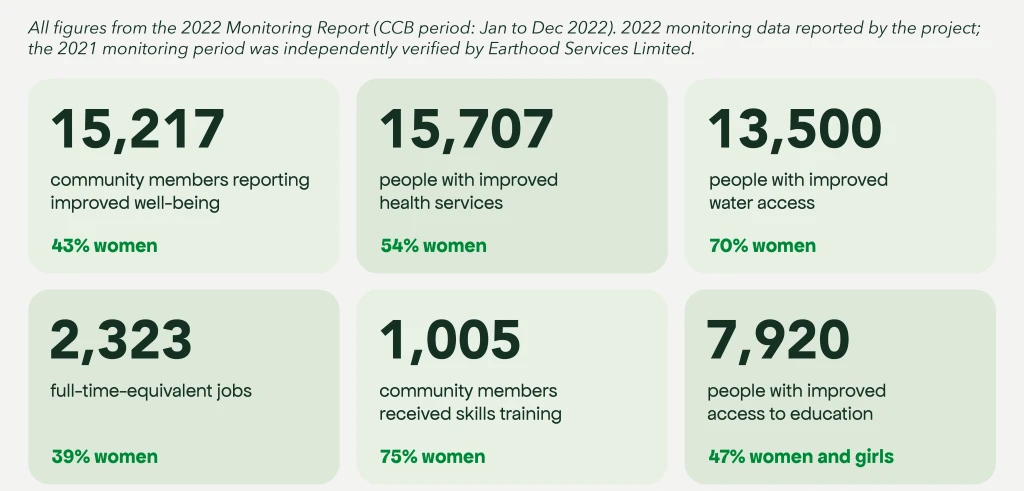
The project's verified community impact for the 2022 monitoring period:
- 15,217 community members reporting improved well-being (43% women)
- 15,707 people with improved health services (54% women)
- 13,500 people with improved water access (70% women)
- 2,323 full-time-equivalent jobs created (39% women)
- 1,005 community members received skills training (75% women)
- 7,920 people with improved access to education (47% women and girls)
All figures from the Fifth Monitoring Report (CCB period: 1 January to 31 December 2022). The 2021 monitoring period was independently verified by Earthood Services Limited.
A Globally Significant Refuge
The project area is one of the few large blocks of intact lowland rainforest left in the western Congo Basin. It safeguards 299,640 hectares of swamp forest, primary forest, periodically flooded forest, and grassy savannah. The project's 2022 monitoring confirmed seven species listed as Vulnerable, Endangered, or Critically Endangered on the IUCN Red List inside the area.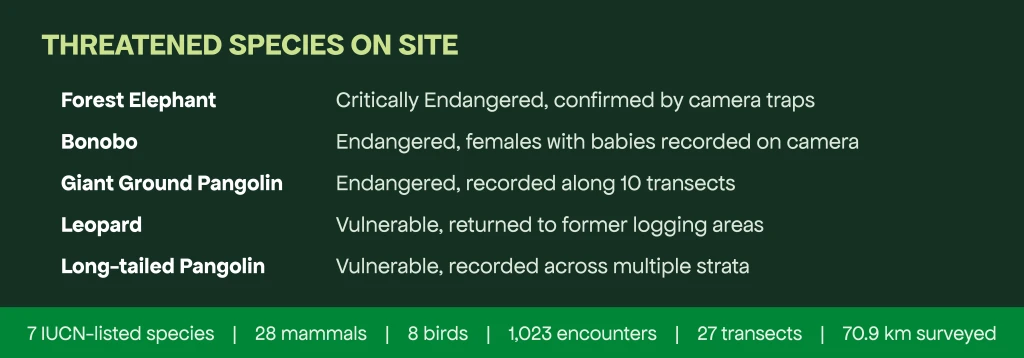
Threatened species confirmed in the project area during the 2022 monitoring period:
Forest elephant (Loxodonta cyclotis): Critically Endangered. Confirmed by camera traps.
Bonobo (Pan paniscus): Endangered. Females with babies recorded on camera traps.
Giant ground pangolin (Smutsia gigantea): Endangered. Recorded along 10 transects.
Leopard (Panthera pardus): Vulnerable. Returned to former logging areas now under protection.
Long-tailed pangolin (Phataginus tetradactyla): Vulnerable. Recorded across multiple forest strata.
Additional threatened species detected via line-transect surveys: Angolan colobus (Vulnerable) and grey-cheeked mangabey (Vulnerable). 2022 survey effort: 27 transects sampled, 70.9 kilometres surveyed on foot, 1,023 wildlife encounters across 36 species (28 mammals, 8 birds).
Two species, the African forest elephant and the bonobo, were directly photographed by camera traps inside the project area during the 2022 monitoring period. Forest elephants, only recently returned to the area, were recorded along seven transects in a former logging stratum that is now under protection. Bonobos were among the ten most frequently encountered species across the surveyed forest strata, and the project reports that most of the female bonobos seen in camera trap footage during 2022 had babies.
Other threatened species detected through line-transect surveys include the giant ground pangolin, long-tailed pangolin, leopard, Angolan colobus, and grey-cheeked mangabey. Across 21 market surveys at five regional markets in 2022, none of the 12 wild animal species recorded for sale were in IUCN threatened categories, which the project reads as a sign that its alternative-protein and awareness programs are taking hold.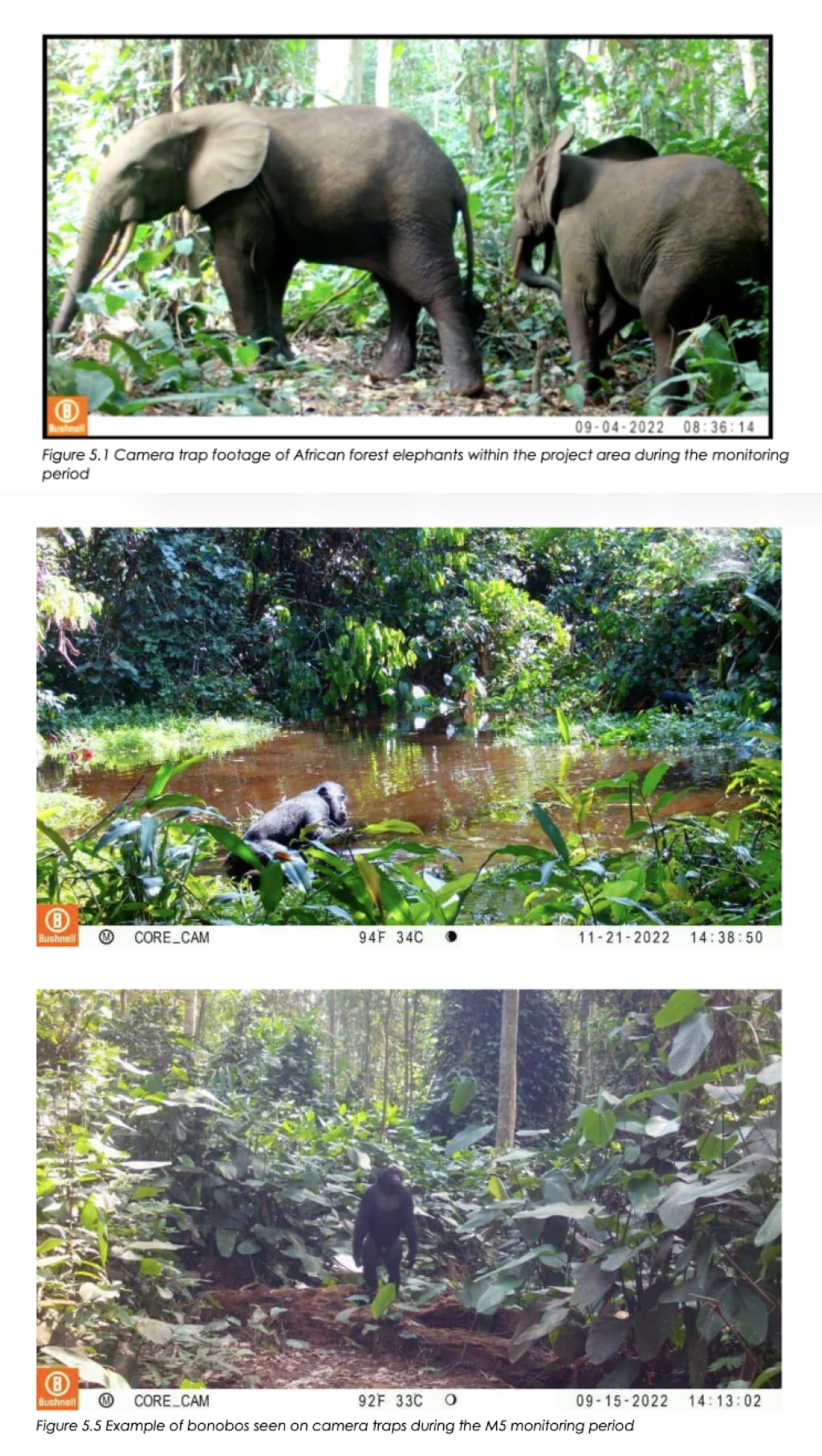
How the Carbon Numbers Work
Evertreen shares this level of detail because transparency matters. The CO2e figures for this REDD+ conservation project are projections calculated under Verra Methodology VM0009, not direct measurements of the atmosphere. Here is how it works: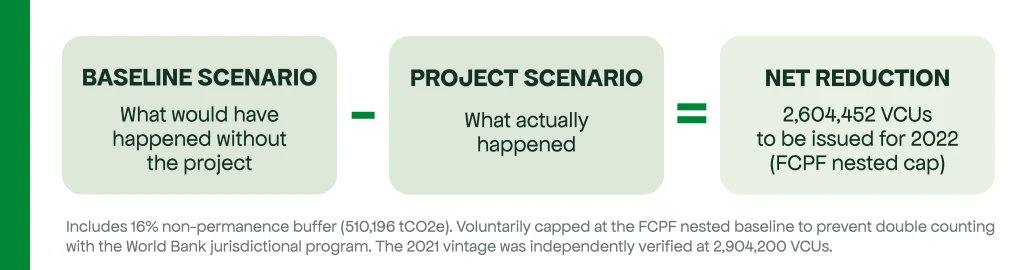 The methodology compares two scenarios. The baseline models what would have happened without the project, in this case, sequential commercial logging followed by slash-and-burn conversion. The project scenario tracks what actually happened: how much forest was cleared inside the project area, how much was displaced to nearby areas (called leakage), and how much carbon stayed in the trees and soil.
For 2022, the project reports baseline emissions of 6,392,829 tCO2e under its validated baseline. After subtracting project emissions, leakage, and a 16 percent buffer pool allocation for non-permanence risk, net emission reductions come to 4,782,428 tCO2e under the validated baseline. The project then applies a more conservative cap, because it is nested into the World Bank Forest Carbon Partnership Facility (FCPF) program for Mai Ndombe Province. Under that cap, 2,604,452 VCUs will be issued for 2022, and 2,904,200 VCUs were issued for the verified 2021 vintage. The cap exists to prevent any double counting between the project's credits and the World Bank jurisdictional program.
Independently Verified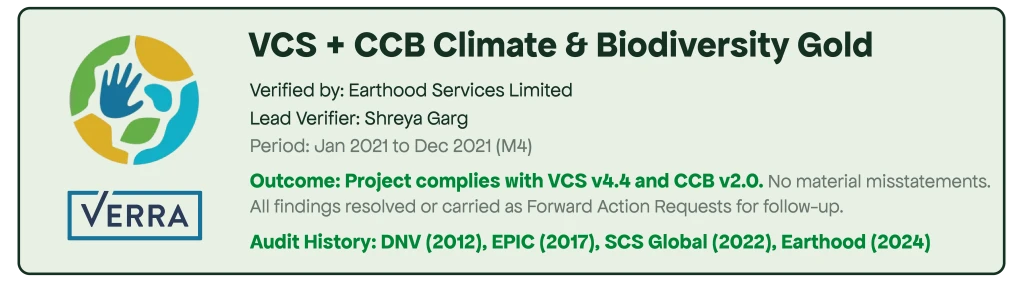
Evertreen selects projects that meet independent verification standards. The Mai Ndombe REDD+ Project is registered under the Verra VCS Standard and co-certified to the Climate, Community and Biodiversity Standards (CCB) v2.0 at the Gold Level for both Climate and Biodiversity. The most recent independent verification was completed by Earthood Services Limited in February 2024, covering the 2021 monitoring period.
Every tree protected here keeps 248,956 hectares of Congo Basin rainforest standing. It keeps forest elephants moving through habitat they only recently returned to. It keeps bonobo mothers safer with their babies. And it keeps carbon stored in one of the most important rainforests left on Earth.
Protect trees in DR Congo through Evertreen.
Frequently Asked Questions
Can I protect trees in the Democratic Republic of Congo through Evertreen? Yes. Evertreen offers to protect trees by supporting The Mai Ndombe REDD+ Project, one of the largest Verra-certified forest conservation projects in central Africa.
How does Evertreen verify its projects? Evertreen selects projects that are backed by independent third-party verification. For this project, all data comes from audited monitoring reports and is publicly available on the Verra registry. Evertreen does not own or operate the project directly. We act as the platform that connects you to certified conservation work.
Can I gift trees in the Democratic Republic of Congo? Yes. Evertreen offers digital gift certificates for trees in the Democratic Republic of Congo and 35+ other countries. It is a meaningful, lasting gift that supports real conservation.
Does this project protect bonobos and forest elephants? Yes. The project area provides habitat for bonobos and forest elephants, both directly photographed on camera traps inside the project area during the 2022 monitoring period. Bonobos are listed as Endangered and forest elephants as Critically Endangered on the IUCN Red List. Other threatened species protected by the project include the giant ground pangolin, long-tailed pangolin, leopard, Angolan colobus, and grey-cheeked mangabey.
Have more questions about how Evertreen works? Visit our FAQ.
Sources: MNRP Fifth Monitoring Report (CCB and VCS), 1 January to 31 December 2022, Version 3.4, issued 11 December 2025. MNRP Fourth Verification Report, issued 15 February 2024 by Earthood Services Limited. Verra Registry VCS 934. CO2e figures are projections under VM0009. Actual VCU issuance is capped under the FCPF nested baseline. The Mai Ndombe REDD+ Project is operated by Wildlife Works Carbon LLC and its in-country subsidiary ERA Congo. Evertreen enables you to support this certified project. Evertreen does not own or operate the project directly.
