

Keo Seima: Cambodia
Discover how Evertreen helps keep 166,983 hectares of Cambodia's evergreen and dipterocarp forest standing for the black-shanked douc, the Bunong people, and 84 globally threatened species.
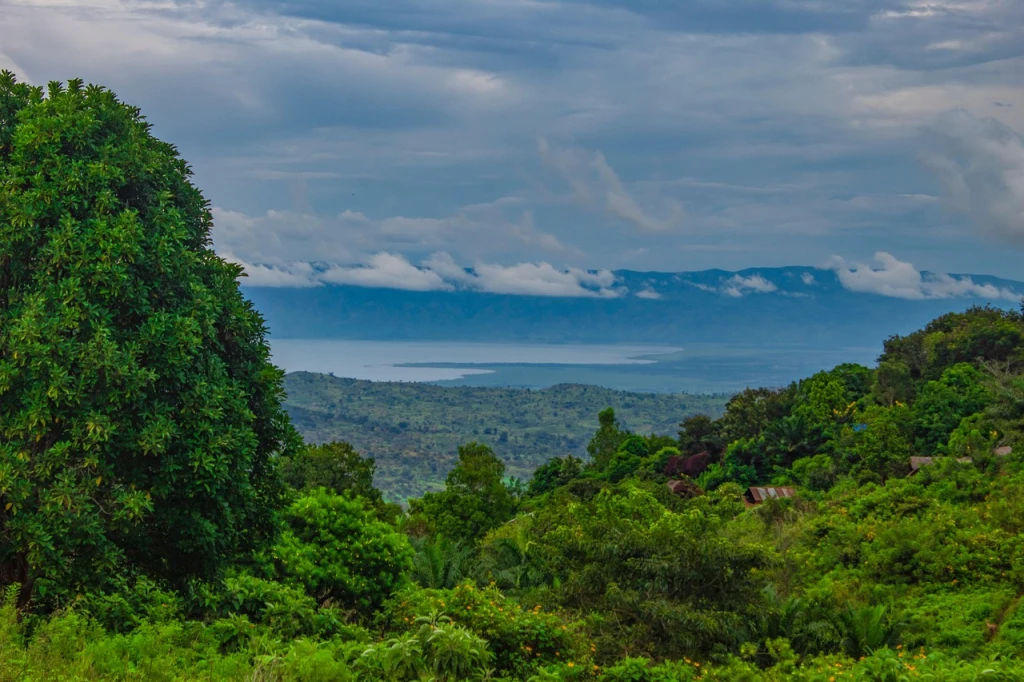
The Keo Seima REDD+ Project
Mondulkiri Province, eastern Cambodia
A 166,983-hectare REDD+ project inside the Keo Seima Wildlife Sanctuary, where the Annamite Mountains meet the lower Mekong dry forests. The project safeguards intact rainforest from agricultural clearance, illegal logging, and economic land concessions, while supporting twenty Bunong and Khmer villages whose lives are bound to the forest.
Protect trees in Cambodia through Evertreen and help keep this forest standing.
At a Glance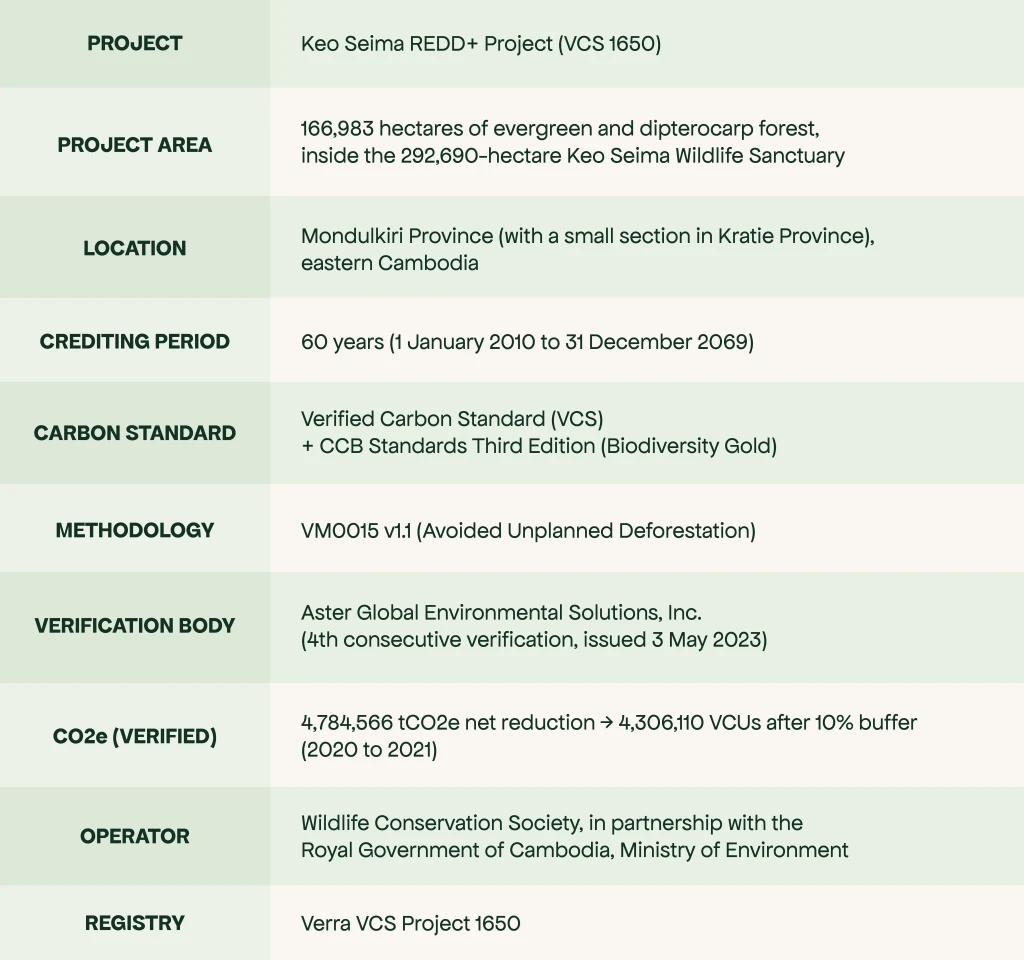
Project: Keo Seima REDD+ Project (VCS 1650)
Location: Mondulkiri Province (with a small section in Kratie Province), eastern Cambodia
Project area: 166,983 hectares of evergreen and dipterocarp forest, inside the 292,690-hectare Keo Seima Wildlife Sanctuary
Operator: Wildlife Conservation Society, in partnership with the Royal Government of Cambodia, Ministry of Environment
Certification: VCS verified + CCB Biodiversity Gold
Methodology: VM0015 v1.1 (Avoided Unplanned Deforestation)
Verifier: Aster Global Environmental Solutions, Inc. (4th consecutive verification, issued 3 May 2023)
Verified emissions reductions (2020 to 2021): 4,784,566 tCO2e net reduction → 4,306,110 VCUs after 10% buffer
Total verified reductions (2010 to 2021): approximately 18.88 million tradable VCUs
Endangered species protected: 84 globally threatened species, including 13 Critically Endangered and 26 Endangered, with the world's largest known populations of black-shanked douc and southern yellow-cheeked crested gibbon
Crediting period: 60 years (1 January 2010 to 31 December 2069)
What This Forest Is Up Against
In 2017, the project found the first two giant ibis nests inside Keo Seima Wildlife Sanctuary. In 2019, the first chicks fledged. By 2021, sixteen nests were detected and protected, with two more successful fledglings raised under the care of Bunong community members trained as nest guards. The giant ibis is one of the rarest large birds left on Earth, classed by IUCN as Critically Endangered, with a global population estimated at a minimum of one hundred breeding pairs. Evertreen connects you to this work.
The Keo Seima Wildlife Sanctuary covers 292,690 hectares in eastern Cambodia, mainly in Mondulkiri Province with a small section in Kratie Province. The site abuts the Vietnamese border. Two ecoregions meet here: the Annamite Mountains, with their high levels of evergreen forest endemism, and the lower Mekong dry forests, with their open dipterocarp woodlands. Eighty-four globally threatened species live inside the project area, including 13 classed as Critically Endangered and 26 as Endangered.
The threat is not abstract. The forest faces a slow-moving frontier of clearance pushing in from outside the sanctuary. Smallholders and migrants looking for somewhere new to clear and plant. Economic land concessions in the surrounding region. Illegal selective logging of rare luxury-grade timber. Each hectare cleared at the edge narrows the range of the giant ibis, the black-shanked douc, and the Asian elephant, and chips away at the only remaining home of nineteen ethnic Bunong villages whose spiritual life is rooted in named spirit forests, spirit pools, and grave forests inside the protected area.
What the Project Does
When you protect trees in Cambodia through Evertreen, your contribution supports three areas of work, all delivered on the ground by the Wildlife Conservation Society and the Cambodian Ministry of Environment.
SMART patrols across a 166,983-hectare protected forest
Joint patrol teams from the Ministry of Environment and the Wildlife Conservation Society conduct law-enforcement and community patrols across the sanctuary using the SMART (Spatial Monitoring and Reporting Tool) system. Forest cover is monitored continuously through USGS Landsat imagery at 30-metre resolution, supplemented by European Space Agency Sentinel-2 imagery at 10-metre resolution to catch smaller clearances the default classification would miss. The carbon project area covers 166,983 hectares of forest inside the larger 292,690-hectare sanctuary, with detectable patrol coverage running across the protected area through the latest verification period.
Indigenous land titles and the spirit forests
For nineteen of the twenty villages that share this forest, the most important places do not appear on standard maps of Cambodia. They are spirit forests, spirit pools, and the grave forests of ancestors. Nine of those villages have already mapped their sacred sites with the project. These are the places that Indigenous Community Land Titles, or ICTs, are designed to protect. Seven Bunong communities have received an ICT to date. Eight more are in process. Three Community Protected Areas have been formally established, two of them during the latest monitoring period, with another four in the pipeline. These titles protect community land rights inside the sanctuary and give villages legal standing to manage forest resources their families have used for generations.
Carbon revenue sharing and alternative livelihoods
Carbon revenue flows back to participating communities through a Cash for Communities programme. In 2017 the project distributed US$238,554 across the twenty villages. In 2021 a further US$200,000 was distributed. Communities decide how to spend the funds, with project staff verifying that planned activities meet basic governance and equity standards. Funded items during the latest monitoring period included pump wells, school materials, road repair, and meeting halls. Alongside this, the project supports organic wildlife-friendly rice through the IBIS Rice conservation enterprise, ecotourism at the Jahoo Gibbon Camp where visitors can hear gibbons sing at dawn, and sustainable harvesting of non-timber forest products including resin, bamboo, honey, and rattan. Almost 80 farmers in the south-east of the sanctuary committed to wildlife-friendly rice during 2020 and 2021. Of those, 58 met all the requirements of their conservation agreement and were eligible to sell at premium. During the same monitoring period, 596 full-time-equivalent jobs were supported through project activities, and 3,226 community members improved their skills through project training, of whom 1,660 were women.
Real Numbers, Real People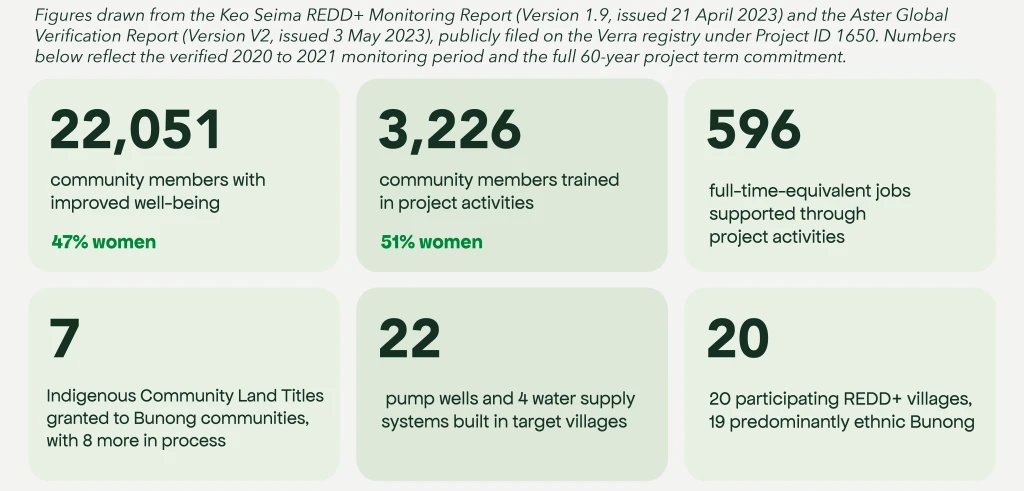
In 2020 and 2021 alone, the Keo Seima REDD+ Project delivered:
22,051 community members with improved well-being (47% women)
3,226 community members trained in project activities (51% women)
596 full-time-equivalent jobs supported through project activities
7 Indigenous Community Land Titles granted to Bunong communities, with 8 more in process
22 pump wells and 4 water supply systems built in target villages
20 participating villages, 19 predominantly ethnic Bunong
Beyond the numbers: the project distributed US$200,000 in carbon revenue to its twenty partner villages through the Cash for Communities programme in 2021 alone, supported 58 farmers to meet all requirements for premium wildlife-friendly rice through the IBIS Rice conservation enterprise, mapped sacred spirit forests, spirit pools, and grave forests with nine Bunong villages, ran ecotourism at the Jahoo Gibbon Camp where visitors can hear southern yellow-cheeked crested gibbons sing at dawn, and trained community nest guards who protected sixteen giant ibis nests detected during 2021.
A Globally Significant Refuge
The Keo Seima Wildlife Sanctuary supports the world's largest known population of two endangered primates: the southern yellow-cheeked crested gibbon, with around 1,432 individuals, and the Critically Endangered black-shanked douc, with around 23,628 individuals. Both populations have remained stable since project inception in 2010, against a global decline of more than fifty percent across three generations. That stability is what carbon revenue and on-the-ground patrols have bought.
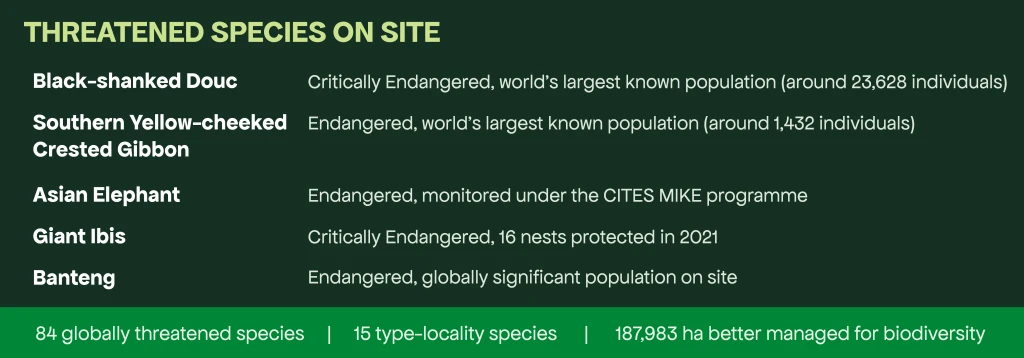 The project area is one of very few places in the world where the giant ibis still nests. The forests are home to the Asian elephant, a globally significant population of banteng, and gaur, sambar, dhole, sun bear, and clouded leopard, alongside birds like green peafowl, white-shouldered ibis, white-rumped vulture, and red-headed vulture, all Critically Endangered or Endangered. The site is the type locality of fifteen species, including two amphibians described to science from this protected area: the O'Reang horned frog and Mouhot's litter frog.
Bi-annual line-transect distance sampling on a fixed network of forty four-kilometre square transects gives the project a robust biodiversity record. In the 2020 sampling session, teams walked a combined 1,280 kilometres and made 560 observations of 2,016 individual animals across six ungulate species, six primate species, and one bird species. The most recent verification confirmed that 187,983 hectares are significantly better managed for biodiversity through project activities, and that 13 Critically Endangered and 26 Endangered species benefit from reduced threats as a direct result of project work.
How the Carbon Numbers Work
The methodology compares two scenarios. The baseline models what would have happened without the project, in this case continued unplanned deforestation at rates measured across a surrounding Reference Region. The project scenario tracks what actually happened on the ground.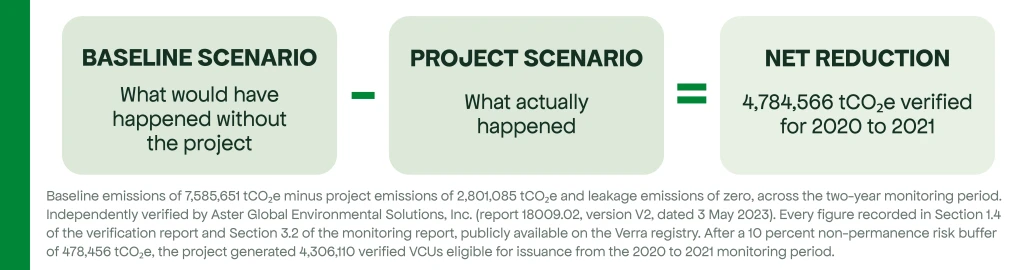 For the 2020 to 2021 monitoring period, baseline emissions were modelled at 7,585,651 tCO2e across the two years. Project emissions came to 2,801,085 tCO2e. Leakage was assessed at zero for this period. The difference produced 4,784,566 tCO2e in net GHG emission reductions. After a 10 percent non-permanence risk buffer of 478,456 tCO2e, the project generated 4,306,110 verified VCUs eligible for issuance from the period. Across the verified record from project start through 2021, ex-post net emission reductions are estimated at 21,171,578 tCO2e cumulative, of which 18,882,906 are tradable VCUs after buffer allocations. For the most current issuance and retirement data, check the Verra registry directly.
Independently Verified
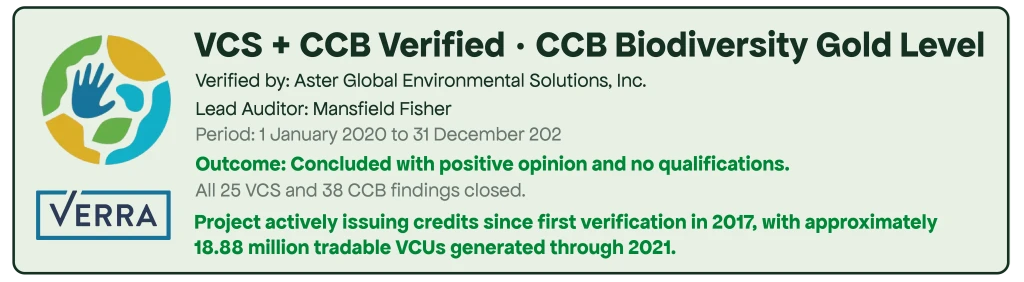 Evertreen selects projects that meet independent verification standards. The Keo Seima REDD+ Project has been verified four times by Aster Global Environmental Solutions, Inc., against the standards of the Verified Carbon Standard and the Climate, Community and Biodiversity Alliance. The most recent verification report, covering the 2020 to 2021 monitoring period, was issued on 3 May 2023 by lead verifier Mansfield Fisher.
The 2020 to 2021 verification was concluded with a positive opinion and no qualifications. All 25 VCS findings and 38 CCB findings raised during the audit were closed across three rounds of review. The project holds CCB Biodiversity Gold Level status and has generated approximately 18.88 million tradable VCUs across the verified period through 2021.
Every hectare protected helps keep 166,983 hectares of Cambodian forest standing. The black-shanked douc is still in the canopy. The giant ibis still nests here. The Bunong villages still walk these trails. Help keep them where they belong, in the forest.
Protect trees in Cambodia through Evertreen.
Frequently Asked Questions
Can I protect trees in Cambodia through Evertreen?
Yes. Evertreen offers tree protection and forest conservation in Cambodia. Your contribution supports the Keo Seima REDD+ Project, a Verra-certified avoided-deforestation project that protects 166,983 hectares of intact rainforest in Mondulkiri Province and is home to the world's largest known population of the Critically Endangered black-shanked douc.
How does Evertreen verify its projects?
Evertreen selects projects that are backed by independent third-party verification. For this project, all data on this page comes from audited monitoring reports that are publicly available on the Verra registry under Project ID 1650. Evertreen does not own or operate the projects directly. Evertreen acts as the platform that connects you to certified conservation work.
Can I gift trees linked to this project?
Yes. Evertreen offers digital gift certificates for forest conservation in Cambodia and 35+ other countries. It is a meaningful, lasting gift that supports real conservation.
Does this project protect endangered species?
Yes. The project area is documented habitat for at least 84 globally threatened species, including 13 Critically Endangered and 26 Endangered. The Critically Endangered black-shanked douc has its largest known global population here, an estimated 23,628 individuals. The site is also home to the Asian elephant, giant ibis, banteng, gaur, dhole, sun bear, clouded leopard, green peafowl, and white-rumped vulture.
Is Evertreen a good option for corporate ESG and CSR reporting?
Yes. The Keo Seima REDD+ Project holds VCS verification and CCB Biodiversity Gold Level status, both widely recognised for corporate sustainability reporting. Evertreen provides tracking, reporting tools, and a public impact page for your company.
Have more questions about how Evertreen works? Visit our FAQ.
Reviewed by Evertreen. Last updated: 10 May 2026.
Sources: Keo Seima Wildlife Sanctuary REDD+ 2020 to 2021 Monitoring Report, Verra Project 1650, version 1.9, dated 21 April 2023; CCB and VCS Verification Report by Aster Global Environmental Solutions, Inc., report ID 18009.02, version V2, issued 3 May 2023; Keo Seima Wildlife Sanctuary REDD+ 2016 to 2017 Monitoring Report, version 3.4, dated 19 November 2018. CO2e figures are projections calculated under VCS Methodology VM0015 v1.1. The Keo Seima REDD+ Project is operated by the Royal Government of Cambodia, Ministry of Environment, with the Wildlife Conservation Society as lead implementing partner. Evertreen enables you to finance this independently certified project. Evertreen does not own or operate the project directly.
Support this project
