

Reforestation in West Virginia
Help restore West Virginia's rare red spruce forests on Cheat Mountain — reviving habitat for the Cheat Mountain salamander and protecting Appalachian headwaters.
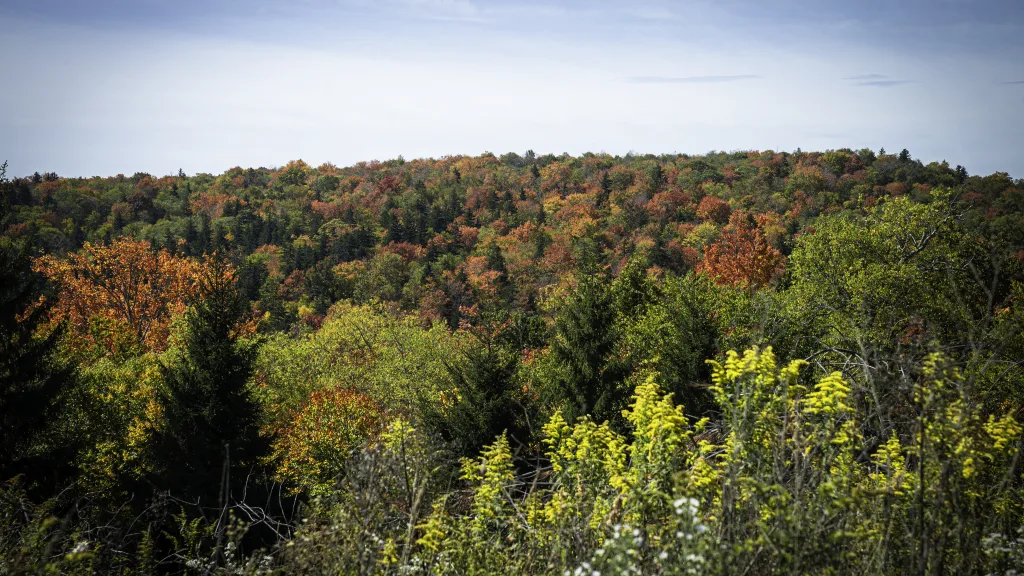 Reforestation in West Virginia
Cheat Mountain, Monongahela National Forest, Randolph County, West Virginia — 38.62° N, 79.90° W
West Virginia is one of the most forested states in the United States, with woodland covering nearly 80% of its land. At the heart of its ecological identity stand the high-elevation red spruce forests of the Central Appalachians — rare ecosystems that once stretched across nearly one million acres of West Virginia before industrial logging, fire, and surface coal mining reduced them to fewer than 55,000 acres. The Reforestation in West Virginia project helps bring these forests back to life on Cheat Mountain, within the Monongahela National Forest.
Adopt a tree in West Virginia with Evertreen and help restore the iconic red spruce forests of the Central Appalachians — drawing down carbon, protecting critical headwater watersheds, and rebuilding habitat for wildlife found nowhere else on Earth.
Bringing back the red spruce
Red spruce (Picea rubens) is the signature tree of West Virginia's coolest, highest ridges, growing alongside eastern hemlock, yellow birch, sugar maple, and balsam fir. These are slow, long-lived forests: a red spruce can live 300 to 400 years, and an eastern hemlock 400 to 600. Allowed to mature, they store carbon for centuries, hold water in the landscape, and shelter species that survive nowhere else in the region. Restoring them is not simply about planting trees — it is about rebuilding a complete, functioning ecosystem on Cheat Mountain.
The deforestation crisis in the Central Appalachians
Late nineteenth- and early twentieth-century logging stripped Cheat Mountain of its native red spruce, and the fires that followed consumed organic soils that had taken millennia to form. Through the twentieth century, surface coal mining compacted the ground, removed remaining vegetation, and left behind land incapable of regenerating forest on its own. Where reclamation took place, non-native grasses and conifers were planted, locking these sites into a state of arrested succession.
Without healthy native tree cover and functional soils, these landscapes shed sediment into streams, store far less carbon than intact forest, and cannot support the wildlife that depends on them. The Central Appalachians are also warming, and climate models project steep declines for red spruce by the end of the century. The cool, wet slopes of Cheat Mountain are among the last places in West Virginia able to sustain it — which makes restoration here a genuine strategic priority.
About the project
The project focuses on restoring native red spruce and northern hardwood forest across degraded former mine lands and legacy reclamation sites on Cheat Mountain, in the Monongahela National Forest — including areas such as the 40,000-acre Mower Tract, where thousands of acres were once strip-mined for coal. The goal is to re-establish a working red spruce ecosystem that can support rare and threatened wildlife, improve water quality in the Shavers Fork watershed, and reconnect fragmented high-elevation habitat.
Species selection prioritises the natives that historically defined this landscape: red spruce, balsam fir, big-toothed aspen, yellow birch, sugar maple, and eastern hemlock. Restoration work goes beyond planting to include decompacting hardened soils, restoring wetlands and natural hydrology, and removing non-native species so that young trees have the best possible chance to thrive. Evertreen supports these efforts by connecting individuals and companies with active planting initiatives on the ground, channelling resources to where restoration can deliver the greatest environmental and community benefit.
Wildlife and watersheds
Red spruce forests are among the most biodiverse ecosystems in the eastern United States, providing habitat for species found nowhere else. Restoring tree cover on Cheat Mountain benefits the Cheat Mountain salamander, the West Virginia northern flying squirrel, the northern goshawk, black bear, and native eastern brook trout. As the canopy returns, soils stabilise, streams run cooler and clearer, sediment loads fall, and habitat connectivity is restored across the high Appalachian landscape — protecting the headwaters that supply clean water to communities downstream.
Supporting West Virginia communities
Communities across Randolph, Pocahontas, and Tucker counties are central to this work. Reforestation creates meaningful employment in nursery operations, site preparation, tree planting, and long-term monitoring and stewardship, building local expertise and a lasting commitment to the restored land. As former coal communities diversify their economies, healthy forests also strengthen a growing outdoor-recreation economy — hunting, fishing, hiking, and ecotourism that all depend on intact, living landscapes.
A restoration measured in generations
Rebuilding a red spruce ecosystem at scale is a process measured in decades. It calls for sustained commitment, careful species selection, and deep collaboration between communities, public land managers, and conservation partners. As these forests mature, they will widen wildlife corridors, strengthen watershed protection, sequester carbon, and reinforce the region's resilience to a changing climate. Every tree planted on Cheat Mountain is a contribution to a living ecosystem that will shelter biodiversity and communities for generations to come.
Adopt a tree in West Virginia
By supporting reforestation in West Virginia through Evertreen, you contribute to real, measurable impact on the ground: healthier forests, stronger rural communities, and a landscape steadily reclaiming its natural balance. Plant a tree in West Virginia today and help these mountains grow back, one tree at a time.
Support this project
