
Renewable Energy Certificates (RECs) for Business
Renewable Energy Certificates let your company match its electricity use with verified renewable generation and report it under market-based Scope 2. Evertreen sources Green-e–certified RECs from named U.S. projects and retires them on your behalf as an intermediary — we do not own or operate the facilities. A REC matches electricity; it is not a carbon offset.
Talk to us about RECs for your business →
Browse: Forestry · Verra CO₂ Offsets · Gold Standard CO₂ Offsets · Renewable Energy (RECs) · Guarantees of Origin (GOs) · Trees — shop
Where these RECs can be used. The GHG Protocol requires the certificate to come from the same market as the electricity it is matched against. These are U.S. RECs, so they apply to electricity consumed in the United States. If your company is based in Europe or the UK, a U.S. REC cannot be used to support a market-based Scope 2 or RE100 claim for your European consumption — you would need European instruments (Guarantees of Origin, or REGOs in the UK) for that. We would rather say this before you buy than have your auditor say it after.
Ratings agencies (BeZero, Sylvera, Calyx, Renoster) do not rate RECs at all, so an absence of rating here is not a quality signal either way.
How a REC works
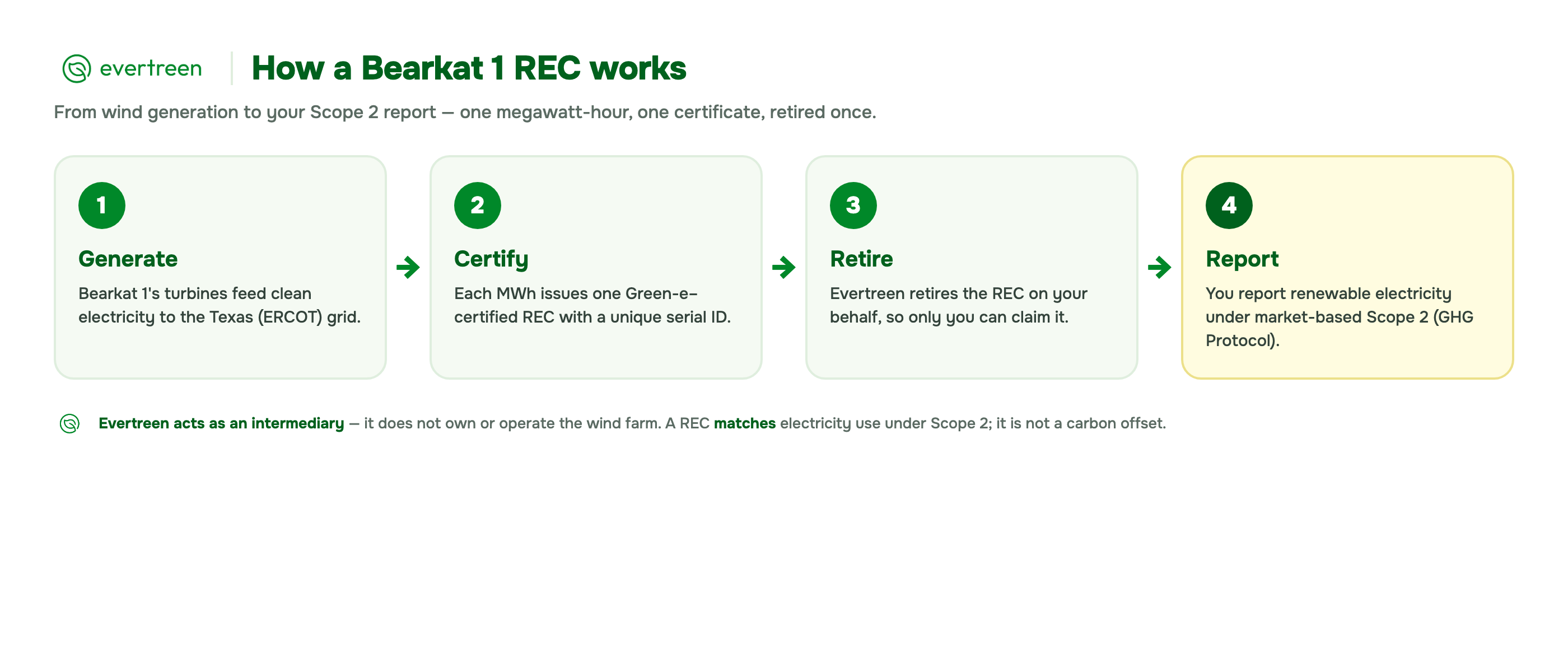
- Generate — a certified renewable facility feeds clean electricity to the grid.
- Certify — each MWh issues one Green-e–certified REC with a unique serial ID.
- Retire — Evertreen retires the REC on your behalf, so only you can claim it.
- Report — you report renewable electricity under market-based Scope 2 (GHG Protocol).
RECs are not carbon offsets
This distinction matters, and Evertreen keeps it clear. A REC represents one MWh of renewable electricity delivered to the grid and is used for market-based Scope 2 electricity reporting. A carbon offset (or carbon credit) represents one tonne of CO₂ reduced or removed and is used against an organisation's wider emissions. We never market a REC as an offset. If your goal is carbon reduction rather than electricity matching, see our reforestation and carbon-credit projects.
What to look for when buying RECs
- Certification — Green-e Energy (or equivalent), independently audited each year.
- Unique ID + retirement — each REC retired in an accredited registry so it cannot be double-counted.
- Named project + vintage — know the facility, technology, location, and year.
- Honest role disclosure — who sources and retires the certificate, and whether they own the facility.
- Reporting support — documentation you can use for market-based Scope 2.
What Evertreen offers
Green-e–certified RECs from named U.S. renewable projects, retired on your behalf with a certificate and the documentation you need for market-based Scope 2 reporting. As an intermediary, Evertreen facilitates and retires the certificates; it does not own or operate the generating facilities. Every project page names the facility, owner/developer, certification, and our exact role.
Our renewable energy projects
Frequently asked questions
What is a Renewable Energy Certificate (REC)?
A REC represents the environmental attributes of one megawatt-hour of renewable electricity delivered to the grid. Buying and retiring it gives you the exclusive right to claim that clean electricity.
Are Evertreen's RECs certified?
Yes. Evertreen sources Green-e Energy–certified RECs, which are independently audited each year, and retires them on your behalf.
Do RECs offset carbon emissions?
No. RECs match your electricity use under market-based Scope 2 reporting; they are not carbon offsets. For carbon reductions, use verified carbon credits or reforestation instead.
How do you prevent double counting?
Each REC carries a unique serial number and is retired in an accredited registry when claimed, and Green-e's annual audit confirms only one party claims each certificate.
What can my company claim after buying?
You can report the matched electricity as renewable under market-based Scope 2 (GHG Protocol), supported by the retirement documentation Evertreen provides.
How do I buy RECs for my business?
Get in touch with Evertreen with your annual electricity use (MWh) and target, and we will match you to a project and handle certification and retirement.
Talk to us about RECs for your business →
Reviewed by Evertreen. Last updated: August 2026.
Sources: Green-e Energy, GHG Protocol Scope 2 Guidance.
