

The Curious Case of the Walking Palm: Socratea exorrhiza
19 Aug 2026 in Green living
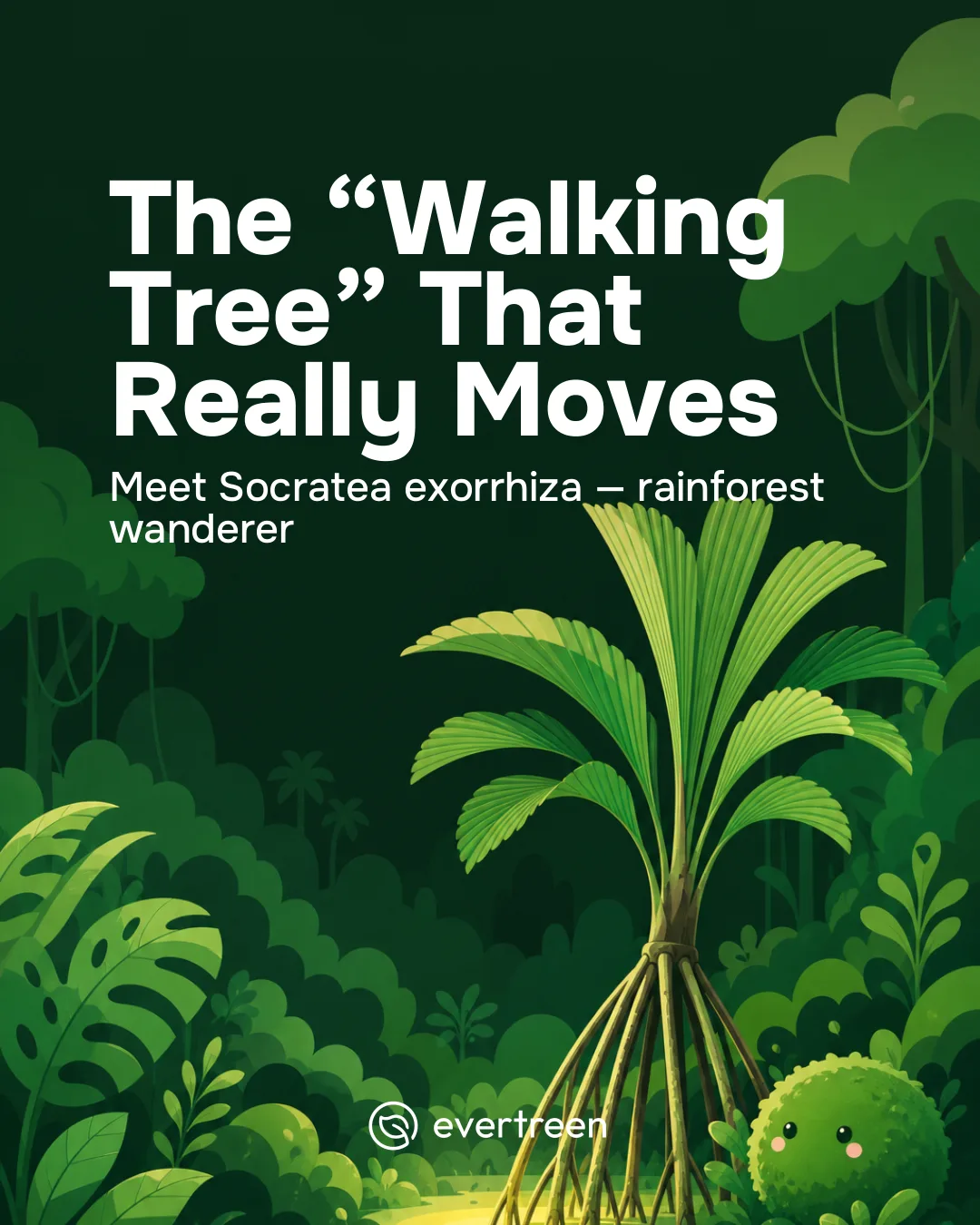
The walking palm (Socratea exorrhiza) does not actually walk. This Central and South American rainforest palm grows a cone of stilt roots that arch a metre or more above the forest floor, and the popular story says it uses them to creep towards sunlight. Field studies that marked and tracked individual palms found the trunks stayed exactly where they started. The roots are an engineering solution, not a means of transport — which is arguably the more interesting answer.
What makes the walking palm unique
- Stilt roots above the soil. Instead of staying buried, the roots emerge from the trunk well above ground and splay outwards into a cone, holding a slender palm several metres up.
- Built for bad ground. Rainforest soils are shallow, wet and easily destabilised. A wide root cone spreads load and resists toppling far better than a narrow taproot.
- Spined and defended. The roots carry sharp spines, which deter climbing animals and reduce damage at the most vulnerable point.
- Cheap height. The stilt structure lets the palm reach the light gap with a thin trunk, using less material than a thick-stemmed tree of the same height.
- Self-righting, up to a point. New roots can grow on the side that needs support, which helps a leaning palm stabilise after debris falls or the ground shifts.
Fact or folklore: where the walking story came from
The legend is not something tourists invented. It began as a genuine scientific hypothesis: that if a falling tree knocked the palm sideways, it could put out new roots on one side, let the old ones on the other side die, and effectively relocate its base — slowly escaping the spot where it was pinned. It is an elegant idea, it fits what the root cone looks like, and it spread quickly through guidebooks and forest tours.
Then people measured it. Researchers marked individual palms and their root crowns and came back to check. The trunks had not moved. New roots do appear and old roots do die, but the centre of the plant stays put — the palm is maintaining and repairing its support structure, not relocating it. Estimates of palms travelling twenty metres through the forest have never survived contact with a tape measure.
The myth survives because it is a better story than "the roots provide mechanical stability", and because the visual evidence is genuinely suggestive: a palm standing on a tangle of legs looks like something caught mid-stride.
Why the real explanation is more impressive
Consider the problem the palm actually solved. It needs to reach light in a dense canopy, on soil too shallow and waterlogged to anchor a heavy trunk, in a place where large debris regularly falls from thirty metres up. A conventional trunk-and-taproot design would need to be far thicker and heavier to stay upright.
The stilt cone solves all three constraints at once: a wide base for stability, a thin and cheap trunk, and a repairable structure where individual supports can be replaced without rebuilding the whole plant. Engineers would recognise it immediately — it is a guyed mast. That the solution also happens to look like legs is a coincidence humans have been enjoying for over a century.
Biodiversity of tropical forests
The walking palm is one player among thousands of rainforest species, and it illustrates a general truth: tropical forests are full of specific answers to specific local problems. That variety is not decorative — it is what makes the system resilient.
- Rainforest diversity buffers the whole ecosystem against pests, disease and climate shifts, because no single failure takes everything with it.
- Structural species matter. Palms like this one create microhabitats: the root cone shelters insects and small animals, and traps leaf litter that feeds the soil.
- Culture counts too. Socratea stems have long been used locally for construction and tools, which is part of why the species is so well known.
- Protecting a species means protecting a system. You cannot conserve a palm without the canopy, the soil and the water cycle it depends on.
From curiosity to action: reforestation that you can check
Stories like this one are a reminder of what is actually at stake in tropical deforestation: not a generic loss of "trees", but the specific, strange, hard-won solutions that evolved in one place and nowhere else. Reforestation is one practical response, and companies fund a meaningful share of it.
Through Evertreen you can support tree planting projects in biodiversity-rich countries from £1.5 per tree, with paid work for the local teams who plant and maintain them. Every tree is geolocated with a GPS pin and documented with progress photos and field videos, so the contribution is verifiable rather than a claim on a slide. Our absorption figures and their assumptions are published in how we estimate tree CO₂, and for organisations that need audited tonnes, certified Verra and Gold Standard credits are available alongside planting.
Frequently asked questions
Do walking palms really walk through the forest? No. Field studies that tracked marked palms found the trunks did not relocate. New roots grow and old ones die, but this maintains the support structure rather than moving the plant.
Why is it called the walking palm then? Because of a long-standing hypothesis that the palm could escape being pinned by falling debris by growing roots on one side and shedding them on the other. The idea spread widely before it was tested.
What are the stilt roots actually for? Stability on shallow, wet rainforest soils, plus a lighter and cheaper way to hold a slender trunk up towards the light. Individual roots can also be replaced if damaged.
Where does Socratea exorrhiza grow? In lowland tropical rainforests across Central and South America, typically in humid, shaded conditions with poor drainage.
How tall does a walking palm get? Commonly upwards of fifteen metres, on a trunk far more slender than a comparable non-palm tree of that height.
Why are walking palms important to rainforest ecosystems? The root cone shelters insects and small animals and traps litter that enriches the soil, and the species is structurally and culturally significant in the forests where it grows.
How can companies support rainforest reforestation? By funding planting projects that are geolocated, monitored and maintained — and by asking for evidence, since traceability is what separates real restoration from a headline number.
