

Katingan Mentaya: Peatland Conservation
Discover how Evertreen is protecting ancient peatland forest in Borneo, supporting local communities, and safeguarding habitat for the Bornean Orangutan.
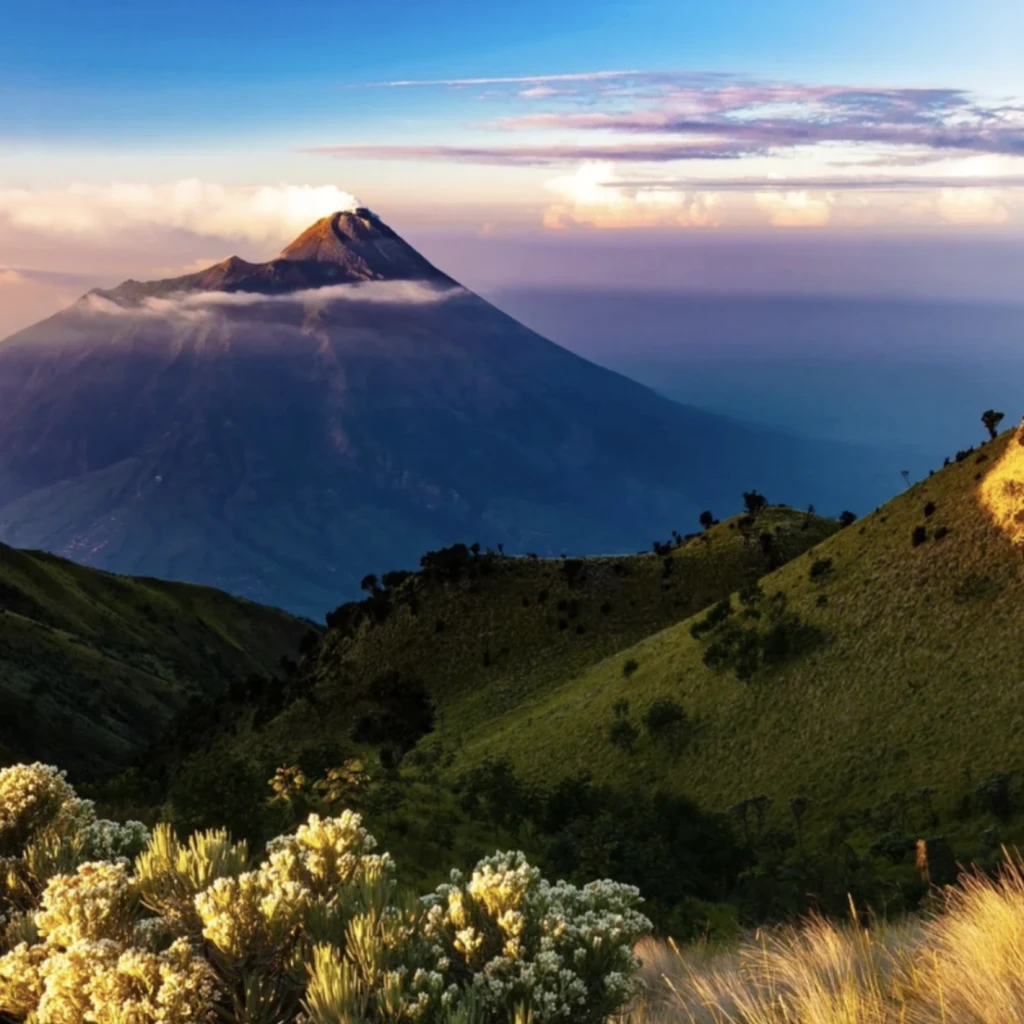
Katingan Mentaya Project
Central Kalimantan, Indonesian Borneo
Protecting 149,800 hectares of ancient peatland forest from industrial conversion, safeguarding one of the largest carbon stores on Earth while supporting the communities who depend on it. This project holds VCS certification with CCB Triple Gold status, the highest possible rating for climate, community, and biodiversity performance.
Plant trees in Indonesia and support this project through Evertreen.
At a Glance
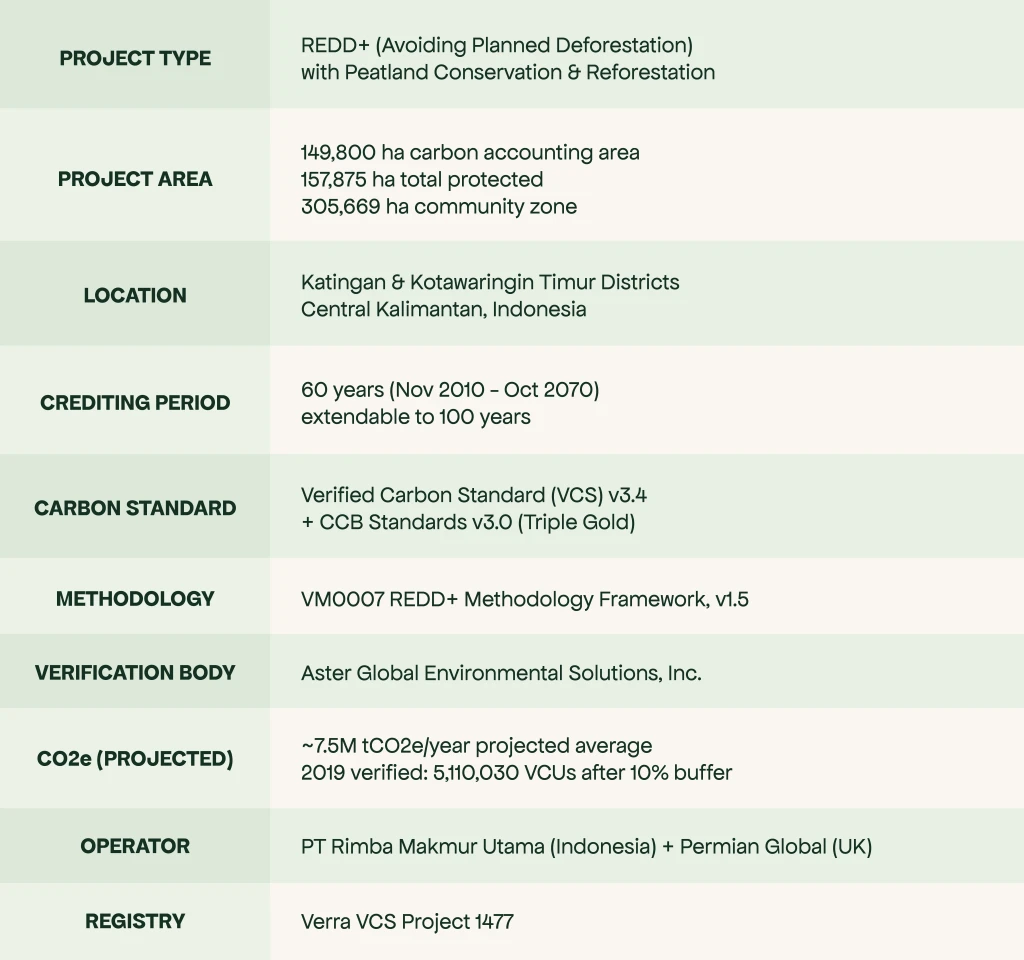
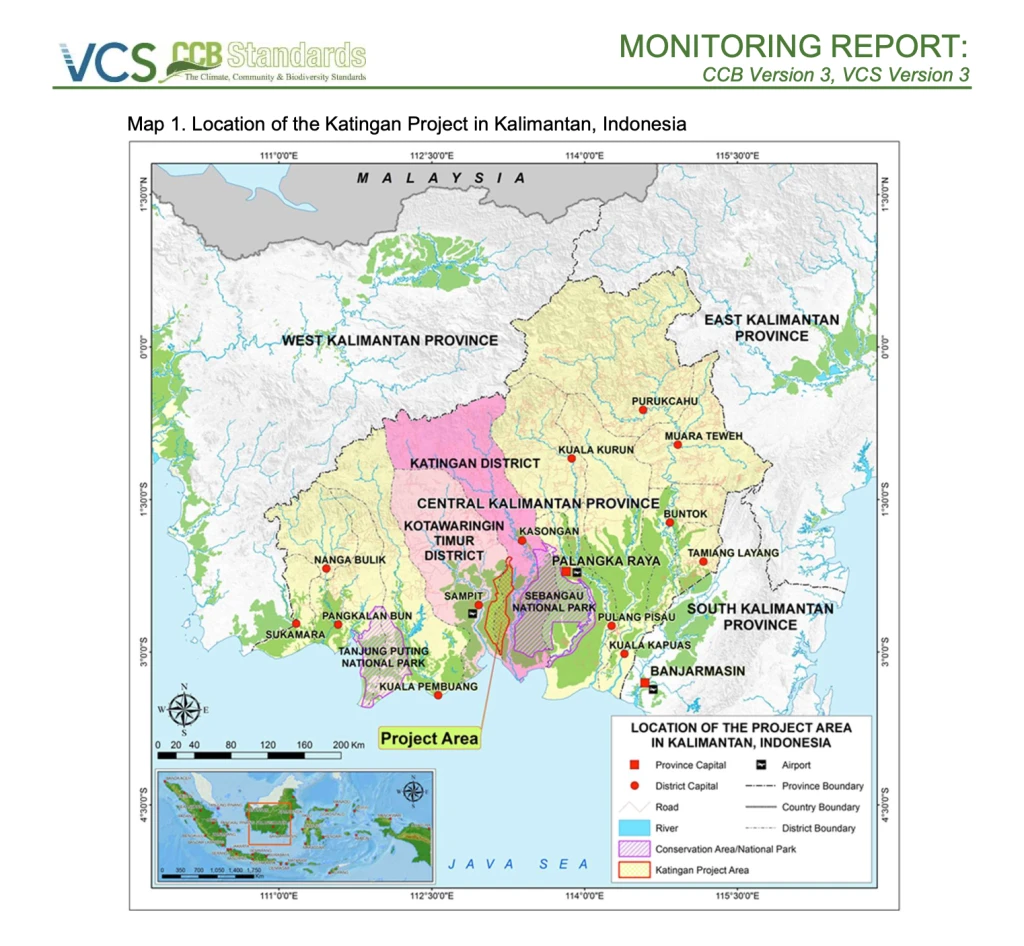
Project type: REDD+ (Avoiding Planned Deforestation) with Peatland Conservation and Reforestation.
Project area: 149,800 ha carbon accounting area, 157,875 ha total protected, 305,669 ha community zone.
Location: Katingan and Kotawaringin Timur Districts, Central Kalimantan, Indonesia.
Crediting period: 60 years (Nov 2010 to Oct 2070), extendable to 100 years.
Carbon standard: Verified Carbon Standard (VCS) v3.4 + CCB Standards v3.0 (Triple Gold).
Methodology: VM0007 REDD+ Methodology Framework, v1.5.
Verification body: Aster Global Environmental Solutions, Inc.
CO2e: ~7.5M tCO2e/year projected average; 2019 verified: 5,110,030 VCUs after 10% buffer.
Operator: PT Rimba Makmur Utama (Indonesia) + Permian Global (UK).
Registry: Verra VCS Project 1477.
What This Forest Is Up Against
Beneath the Katingan Mentaya forest lies a peat dome, a vast, sponge-like mass of waterlogged organic matter that has been building up for 26,000 years, reaching depths of 13 metres in places. This single peat dome stores an estimated 546.75 million tonnes of carbon underground, with another 14.25 million tonnes locked in the trees above.
Before the project existed, this entire area was earmarked for conversion into industrial acacia pulpwood plantations. That would have meant draining the peat, clearing the forest, and releasing centuries of stored carbon into the atmosphere. The project's baseline modelling estimates that without protection, roughly 30% of the project area (around 45,473 hectares) would have been converted by now. This project keeps that from happening.
Draining peatland does not just release carbon. It turns waterlogged soil into dry fuel. Central Kalimantan experienced catastrophic peat fires in 1997 and 2015. Inside the project area, fire incidence has been approximately 25 times lower than in the adjacent Sebangau National Park, a direct result of the project's fire prevention work.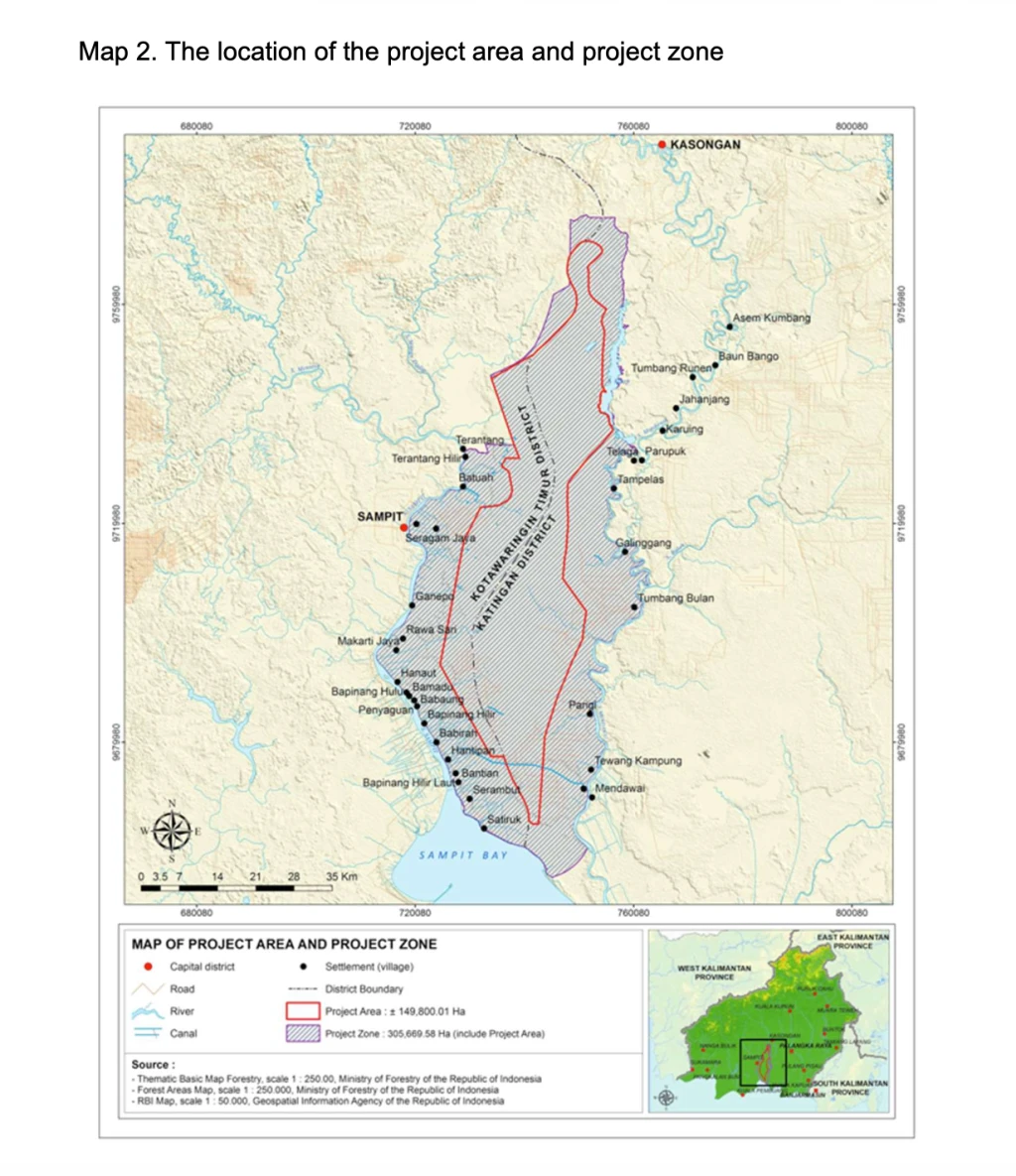
What the Project Does
The project operates under two ecosystem restoration concession licenses issued by the Indonesian government. When you plant trees in Indonesia through Evertreen, your contribution supports three areas of work:
Forest Protection & Fire Prevention
Fire is one of the biggest threats to peatland. The project maintains dedicated fire prevention teams, runs community awareness training, builds firebreaks, and operates early-warning monitoring systems. During 2019, despite 82 fire incidents being recorded, only 156 hectares of forested area were affected. That is the result of rapid detection and trained local response.
Peatland Restoration & Reforestation
The project runs tree nurseries growing 14 native species, including Jelutung Rawa, Shorea Balangeran, and Meranti. Seedlings are raised on site, then planted into degraded areas during the wet season when survival rates are highest. Canal blocking raises the water table to re-wet drained peat, creating the waterlogged conditions these species need to establish. Over 36,000 trees have been planted within the project area and 97,000 more across surrounding communities for agroforestry. A total of 339 hectares of degraded swamp have been actively reforested.
Community Livelihood Programs
The project works with 34 surrounding villages, home to roughly 38,600 people, through a participatory planning process where communities decide what support they need. Programs include microfinance, coconut sugar production, sustainable agriculture training, fish farming, bamboo cultivation, and ecotourism. The project directly employs 197 full-time staff, with hiring priority given to local residents.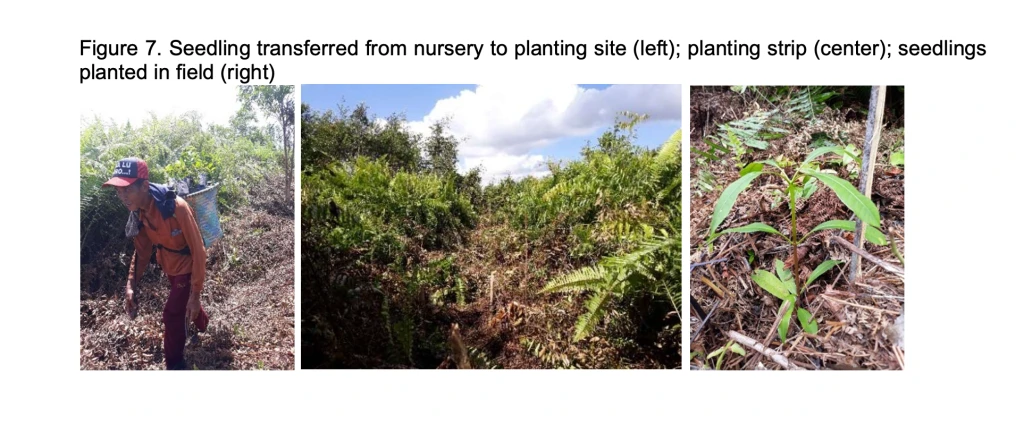
Real Numbers, Real People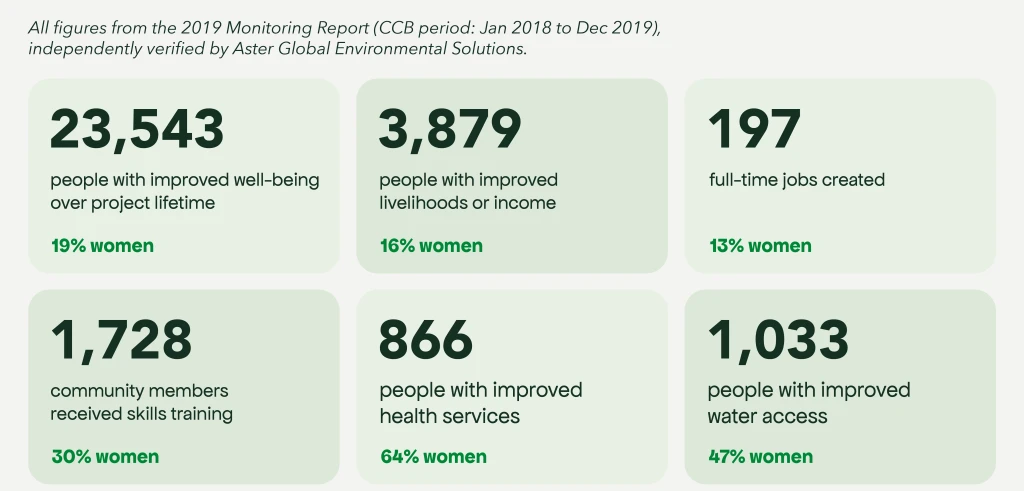
In 2019, the Katingan Mentaya project delivered:
- 23,543 people with improved well-being over project lifetime (19% women)
- 3,879 people with improved livelihoods or income (16% women)
- 197 full-time jobs created (13% women)
- 1,728 community members received skills training (30% women)
- 866 people with improved health services (64% women)
- 1,033 people with improved water access (47% women)
Beyond the numbers: the project provides solar lighting to households without electricity, funds school boats so children in remote villages can reach secondary education, supports community health centres, and runs a microfinance programme that recorded zero loan defaults as of the most recent audit period (2019).
A Globally Significant Refuge
The Katingan Mentaya project area qualifies as a Key Biodiversity Area under multiple international criteria. By the end of 2019, surveys had documented 232 bird species, 69 mammals, 72 reptiles and amphibians, 111 fish, and 312 plants, over 700 species in total.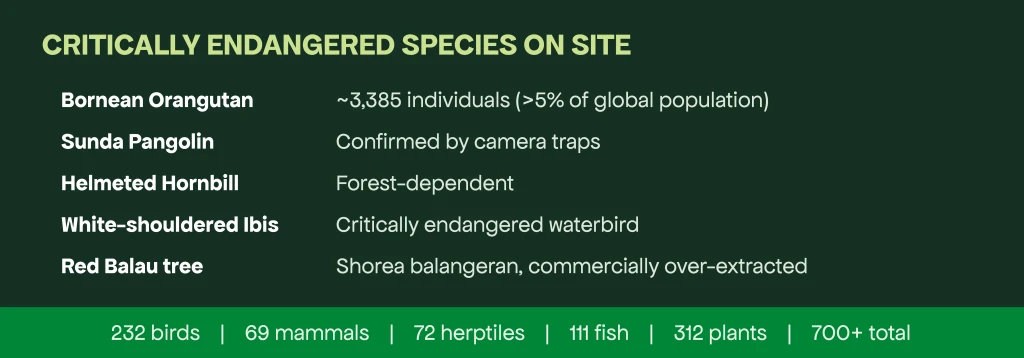 Critically Endangered Species on Site
Bornean Orangutan: nest surveys estimate 3,385 individuals (over 5% of the global population). Sunda Pangolin: confirmed by camera traps. Helmeted Hornbill, White-shouldered Ibis, and Red Balau tree (Shorea balangeran).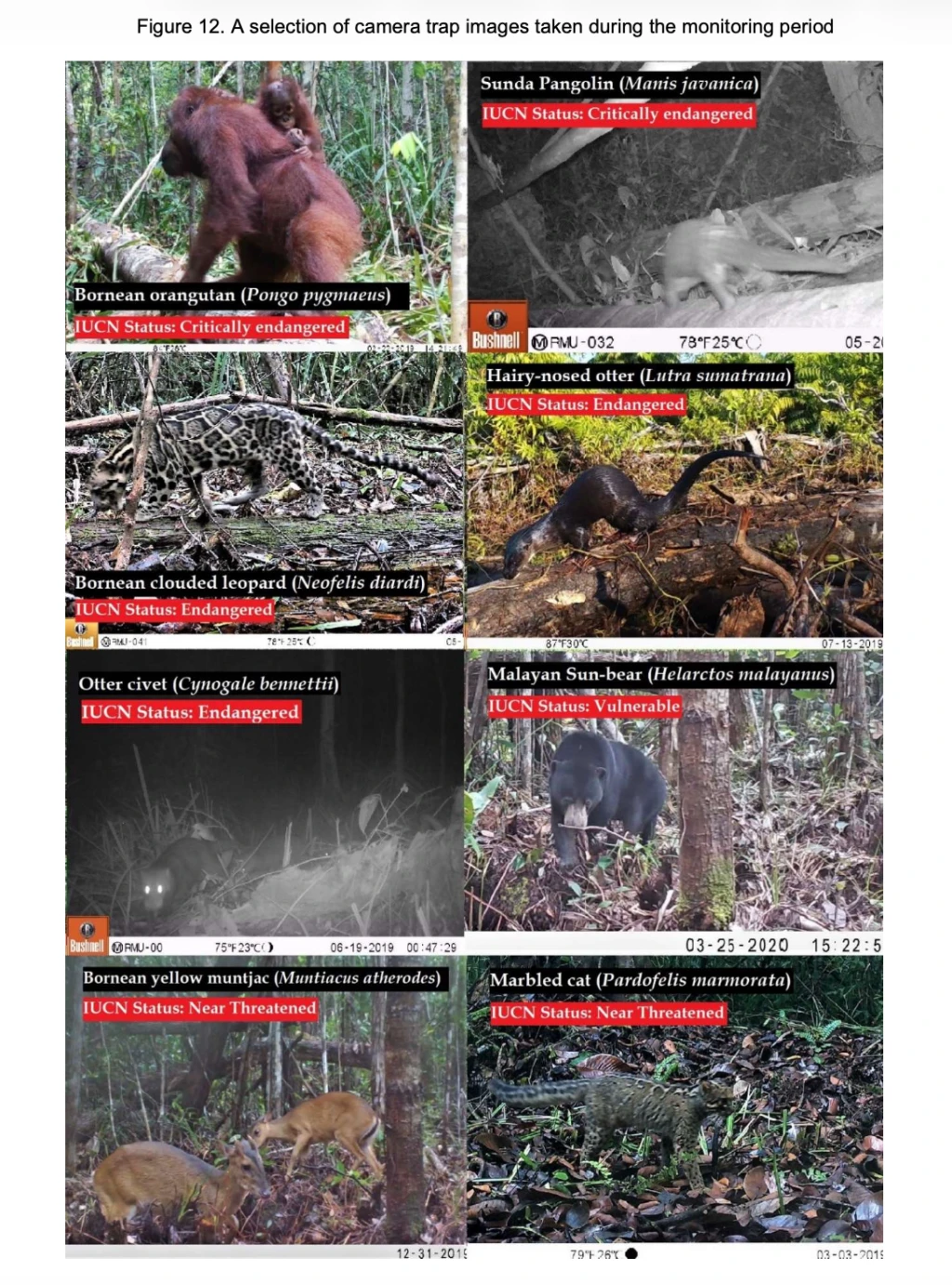 Camera trap surveys across the project area have recorded Bornean Clouded Leopard, Hairy-nosed Otter (one of the rarest otter species in the world), Malayan Sun Bear, and Marbled Cat. Field surveys have also documented Proboscis Monkey (over 5% of the global population) and Helmeted Hornbill within the project area, alongside dozens of other species that depend on intact peat swamp forest.
All 14 tree species used in reforestation are native to Central Kalimantan. No genetically modified organisms or invasive species are used anywhere in the project.
How the Carbon Numbers Work
Evertreen shares this level of detail because transparency matters. The CO₂e figures for this REDD+ conservation project are projections calculated under VCS Methodology VM0007, not direct measurements of the atmosphere. Here is how it works: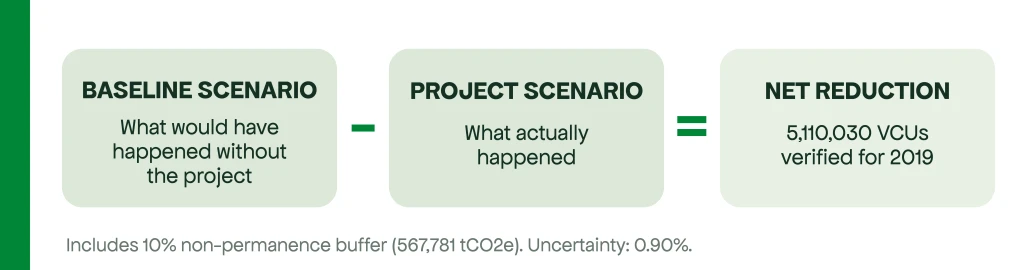 The methodology compares two scenarios. The baseline models what would have happened without the project, in this case, industrial drainage and conversion of the peatland to acacia plantations. The project scenario tracks what actually happened: how much forest was lost to fire, illegal logging, or degradation, and how much peat remained intact.
For 2019, the difference between those two scenarios, after subtracting fire emissions (489,842 tCO₂e) and a 10% non-permanence risk buffer (567,781 tCO₂e held in reserve), came to 5,110,030 verified VCUs. The baseline deforestation rate of 3.91% per year was established using proxy concession analysis over the 10-year pre-baseline period. Combined uncertainty was 0.90%, well below the 15% threshold that would trigger deductions.
The "~7.5 million tCO₂e per year" figure you may see elsewhere is the projected 60-year average. Annual figures vary depending on fire events and other factors. For the most current issuance data, check the Verra registry directly.
Independently Verified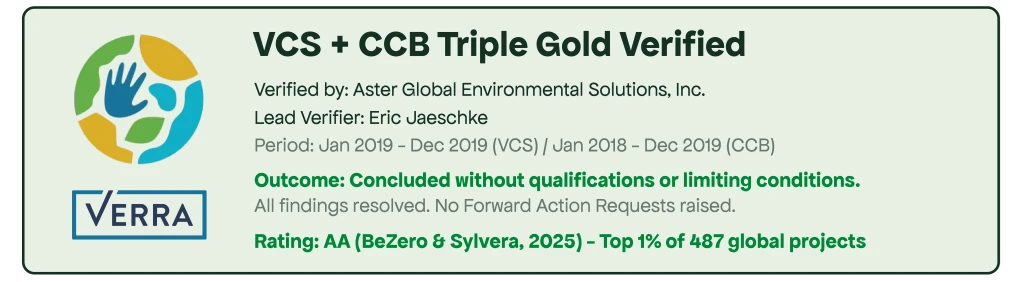
Evertreen selects projects that meet independent verification standards. When you plant trees or support conservation through our platform, the numbers behind your contribution have been independently audited by an accredited third party.
Every tree planted helps keep 149,800 hectares of peatland forest standing, protecting orangutans, supporting communities, and keeping carbon where it belongs: in the ground.
Plant your trees in Indonesia through Evertreen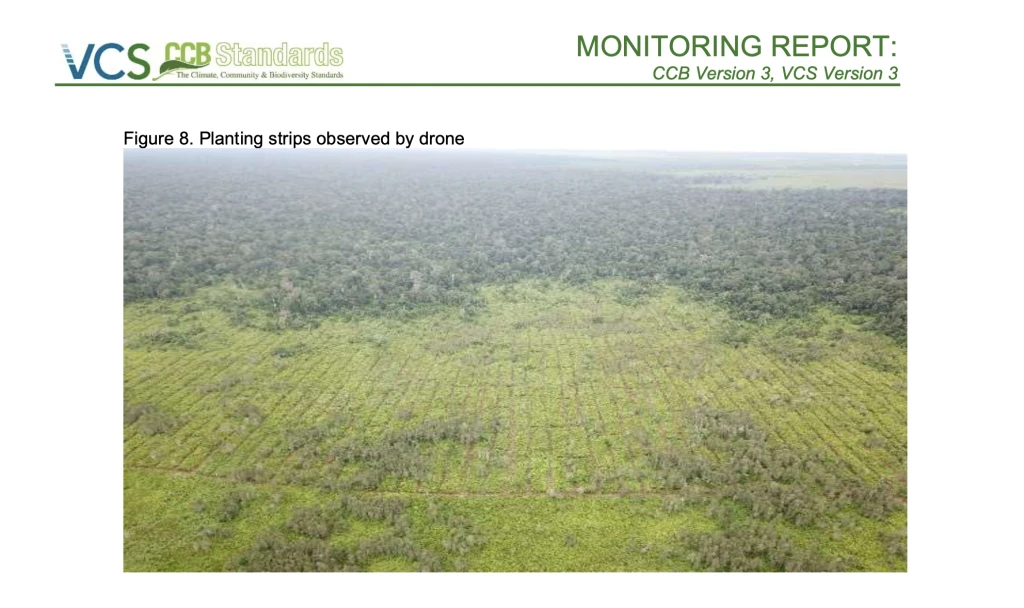
Frequently Asked Questions
Can I plant trees in Indonesia through Evertreen? Yes. Evertreen offers tree planting and forest conservation in Indonesia. Your trees support the Katingan Mentaya peatland conservation project in Borneo, one of the largest Verra-certified peatland conservation projects in the world.
How does Evertreen verify its projects? Evertreen selects projects that are backed by independent third-party verification. For this project, all data comes from audited monitoring reports and is publicly available on the Verra registry. Evertreen does not own or operate the projects directly. We act as the platform that connects you to certified conservation work.
Can I gift trees planted in Indonesia? Yes. Evertreen offers digital gift certificates for trees planted in Indonesia and 35+ other countries. It is a meaningful, lasting gift that supports real conservation.
Does this project protect orangutans? Yes. The project area is home to an estimated 3,385 Bornean Orangutans, over 5% of the global population. Camera traps have also confirmed Sunda Pangolin, Clouded Leopard, and other critically endangered species. Protecting this forest directly protects their habitat.
Have more questions about how Evertreen works? Visit our FAQ.
Reviewed by Evertreen. Last updated: May 2026.
Sources: VCS CCB Katingan Monitoring Report 2019; Aster Global Verification Report 2020; Verra Registry VCS 1477; BeZero Carbon Rating 2025. CO₂e figures are projections under VM0007. The Katingan Mentaya Project is operated by PT Rimba Makmur Utama and Permian Global. Evertreen enables you to support this certified project. Evertreen does not own or operate the project directly.
