

Vohidahy Forest: Madagascar
Tree planting in Madagascar with our partner Tsiryparma, which also guards 8,021 hectares of eastern highland forest at Vohidahy for the lemurs, the rosewood and the village.
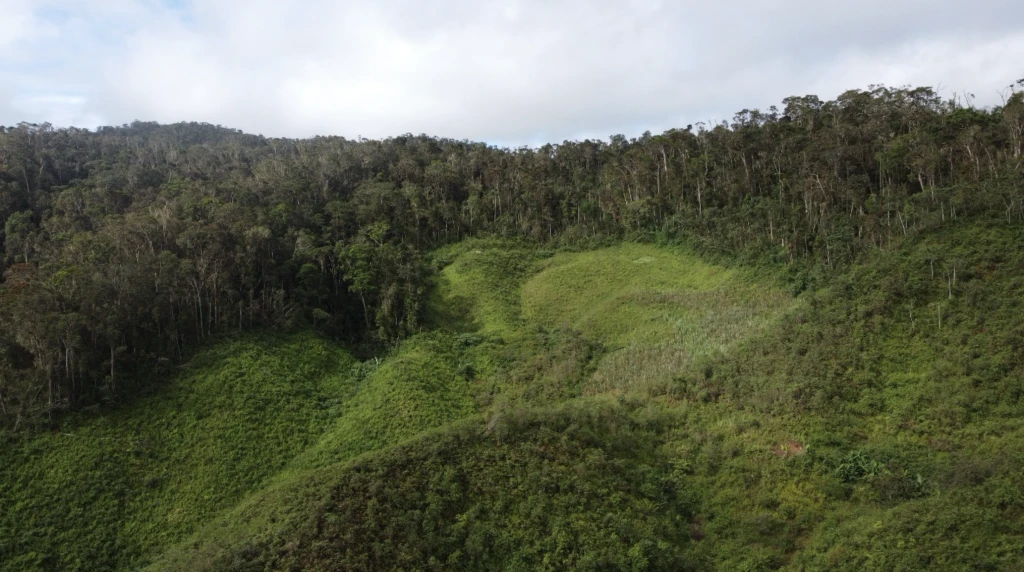 The Vohidahy Project
Commune of Vohidahy, Amoron'i Mania region, central-east Madagascar
A community forest project in central-east Madagascar that protects 8,021 hectares of natural highland forest from slash-and-burn farming, illegal rosewood logging, and clearing for sugarcane. Tsiryparma, the Italian non-profit running the project, was founded in 2011 to continue forestry work that began in Vohidahy in 2006, and runs the forest patrols alongside a women's agricultural association, a coffee and vanilla supply chain, and the village hospital and schools.
Fund tree planting in Madagascar through Evertreen. What we sell here is tree planting; this page also describes Tsiryparma’s work protecting the forest that is still standing, and we do not present either as a certified carbon credit.
At a Glance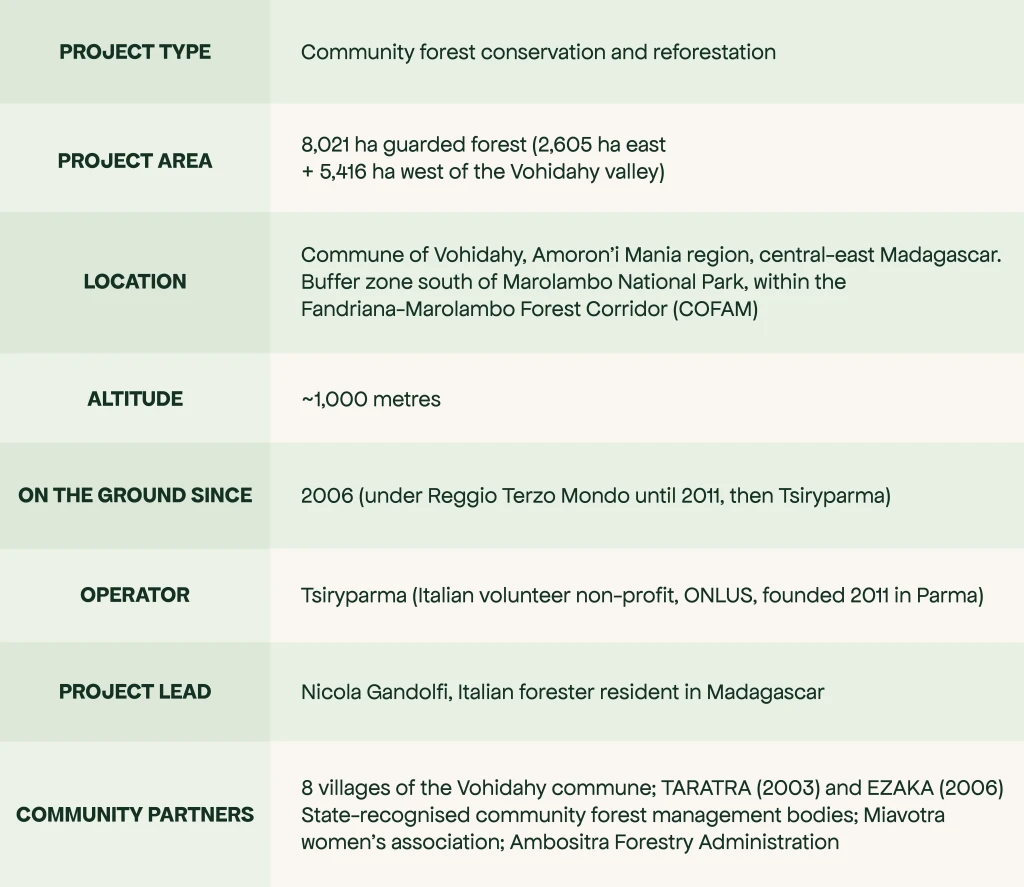
 Project: The Vohidahy Project (Il Progetto di Vohidahy)
Location: Commune of Vohidahy, Amoron'i Mania region, central-east Madagascar
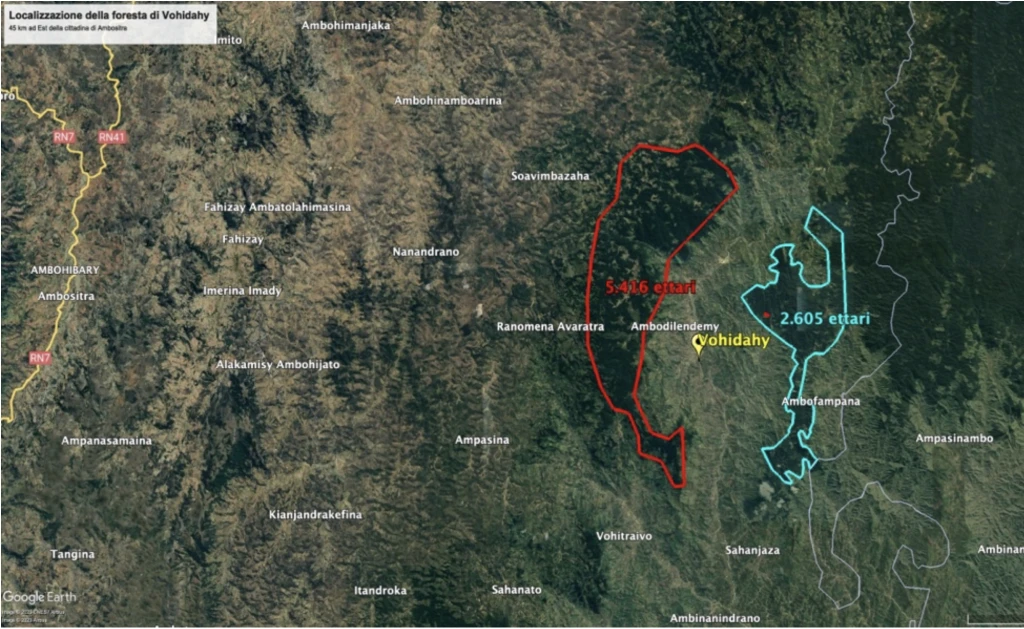
Project area: 8,021 hectares of guarded natural forest, split into a 2,605-hectare eastern block and a 5,416-hectare western block around the Vohidahy valley
Ecosystem: Highland tropical forest at roughly 1,000 metres altitude, in the buffer zone south of Fandriana-Marolambo National Park
Community: Approximately 11,000 inhabitants across 8 villages; the community forest management groups TARATRA and EZAKA hold the local management rights, transferred from the Malagasy State in 2003 and 2006 respectively
Operator: Tsiryparma (ONLUS TsiryParma), an Italian volunteer non-profit founded in Parma in 2011 and registered under Italian Law 266/91
Project lead on the ground: Nicola Gandolfi, Italian forester and naturalist, working in Madagascar since 2006
Seedlings produced in the region: 80,486 since 2018, raised in roughly 40 Tsiryparma nurseries split between the Vohidahy valley and the Ambositra countryside (Amoron'i Mania region only; our wider Madagascar planting, including the Kimony mangroves, is set out on the Madagascar project page)
Anchor programs: The Custodi della Foresta forest guardian team (22 people); the Miavotra women's environmental association; coffee and vanilla supply chains; the Agricultural Training Centre, built in 2018; the Vohidahy hospital, inaugurated 2022; child sponsorship for 22 children
Partners: Caritas Children di Parma; the Italian Waldensian Church (Chiesa Valdese); SEVA; the Ambositra Forestry Administration; and additional Italian and international organisations listed on the operator's website
What This Forest Is Up Against
Walk through Vohidahy and the threats are visible from the trailhead. Small distillation stills sit hidden in the forest where farmers turn sugarcane into toaka gasy, the local rum. Dark stumps mark where rosewood trees have been felled illegally for the timber market in Ambositra and the capital. Burn scars show where a household has cleared another patch with fire to plant next year's rice. Each of these is illegal. Each pays better than the alternatives. Evertreen connects you to the people working to change that calculation.
Madagascar has lost more than 90 percent of its original forest cover. The forest the project protects is a rare exception: a continuous block of natural highland forest in the buffer zone south of Fandriana-Marolambo National Park, where roughly 9,000 hectares of the commune's land is still under canopy. The drivers of clearance are concrete and well-documented. Slash-and-burn agriculture, locally called tavy, cycles through a plot for a few years until the soil is exhausted, then moves on. Rosewood from the endemic species Dalbergia monticola is felled illegally and trafficked to Ambositra. Hunters still take lemurs for meat. Sugarcane and the distilled rum it produces are the highest-paying cash crop in the region, and they need cleared land.
Without the project, the cycle of clearance carries on undocumented. Madagascar holds more than 200,000 species and roughly 70 percent of them are endemic to the island. Every continuous block of natural highland forest that survives in Amoron'i Mania is a refuge for species you will not find anywhere else. The Vohidahy block is one of them, and the village that lives next to it has chosen to keep it standing.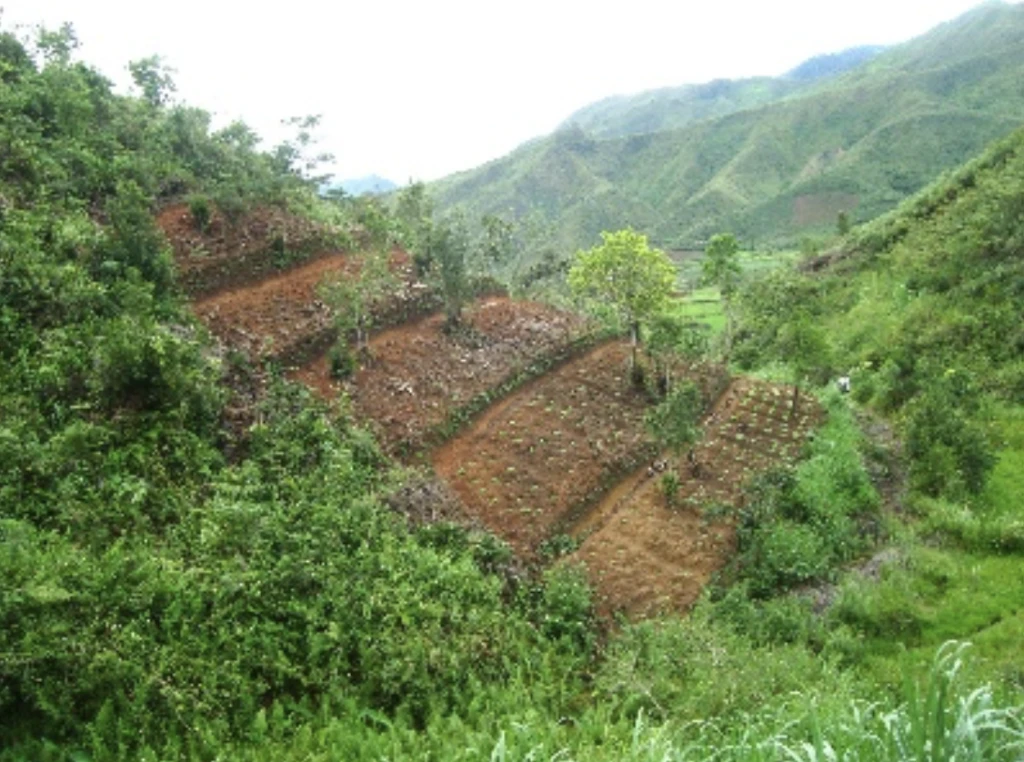
What the Project Does
Tsiryparma’s work at Vohidahy covers three areas. What Evertreen offers here is tree planting in Madagascar; the patrols and programmes below are part of the partner’s wider work.
Forest patrols across 8,021 hectares of guarded forest
A team of 22 Vohidahy residents called I Custodi della Foresta (the Guardians of the Forest) carry out forest control missions about five days every month. The team has six leaders and 16 guardians, two for each of the eight villages in the commune, supported by a Tsiryparma technician on the ground and by four agents from the Ambositra Forestry Administration who join the longer twice-yearly missions of eight days each. They protect 8,021 hectares in total, split into the 2,605-hectare block east of the Vohidahy valley and the 5,416-hectare block to the west. Their job is concrete: walk the forest, document illegal logging and burning, talk to the villages about what the forest is worth standing.
The Miavotra women's association and the village's social anchors
The Miavotra women's environmental association was founded by the women of Vohidahy with Tsiryparma's support. About five days of training a month run from the Agricultural Training and Literacy Centre, built in 2018, covering sustainable agriculture, agroforestry, business management, and literacy. The hospital in Vohidahy, rebuilt with funding from the Italian Waldensian Church (Chiesa Valdese) and inaugurated in spring 2022, is now the medical reference point for roughly 11,000 people who previously had to travel to Ambositra. Three Catholic nursery schools run by Tsiryparma serve the youngest children. Caritas Children di Parma's distance-sponsorship program (Sostegno a Distanza) covers school costs and materials for 22 children at present.
Coffee, vanilla, and the agroforestry supply chains
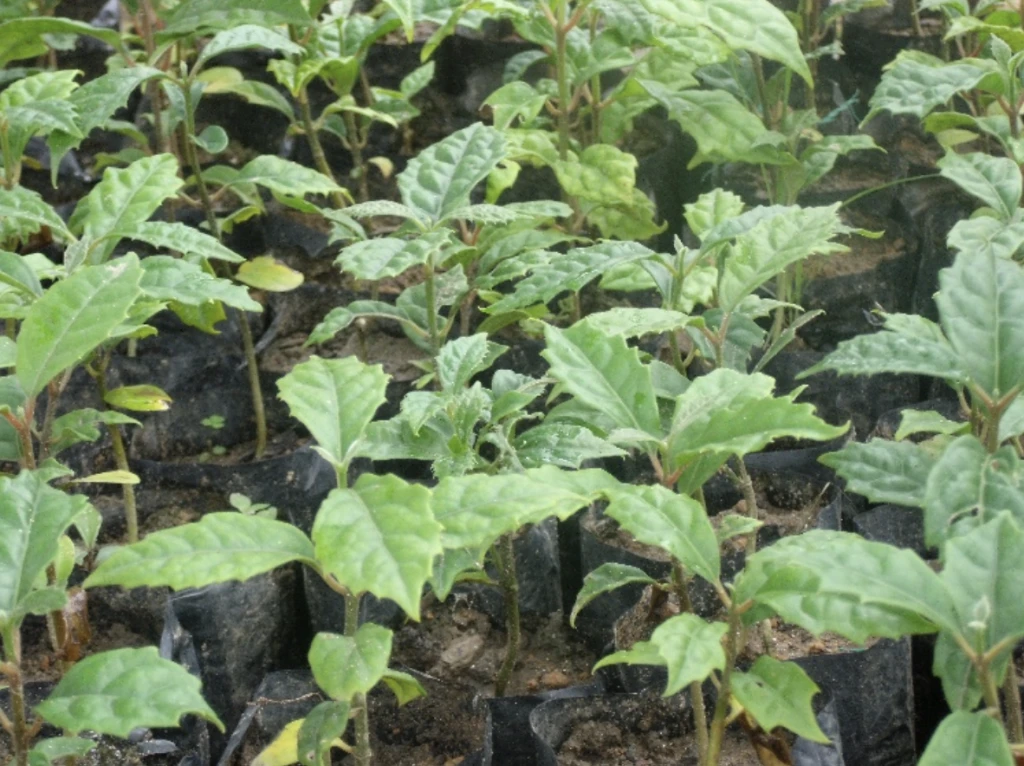
Tsiryparma develops cash crops that take pressure off the forest by giving farmers a reason not to burn it. The coffee project plants Arabica along the outer edge of the natural forest, where conditions at roughly 1,000 metres of altitude favour it. An existing plantation in the area produces about 300 kg of green coffee a year and serves as the working demonstration. The vanilla project, started in 2019, now has around 200 farmers in the valley producing organic vanilla, hand-pollinated each December and harvested in August and September. Across both crops and the wider Amoron'i Mania region, Tsiryparma has produced 80,486 seedlings since 2018, raised in roughly 40 nurseries split between Vohidahy and the Ambositra countryside, about 80 percent of them in Tsiryparma's own nurseries rather than bought in.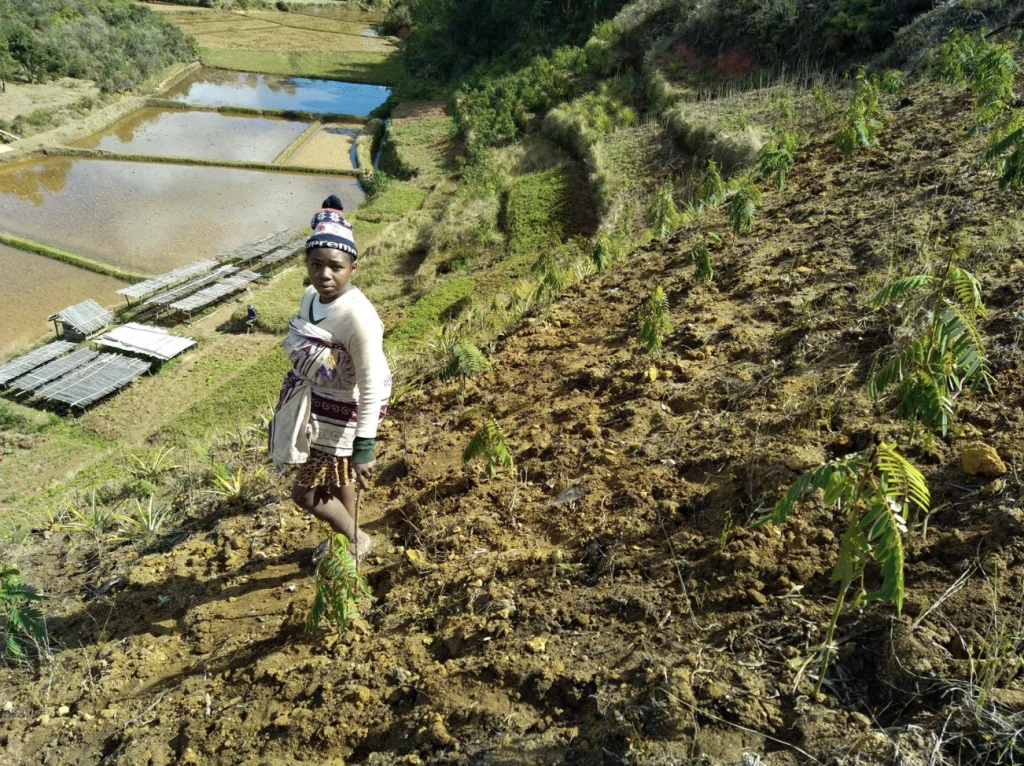
Real Numbers, Real People
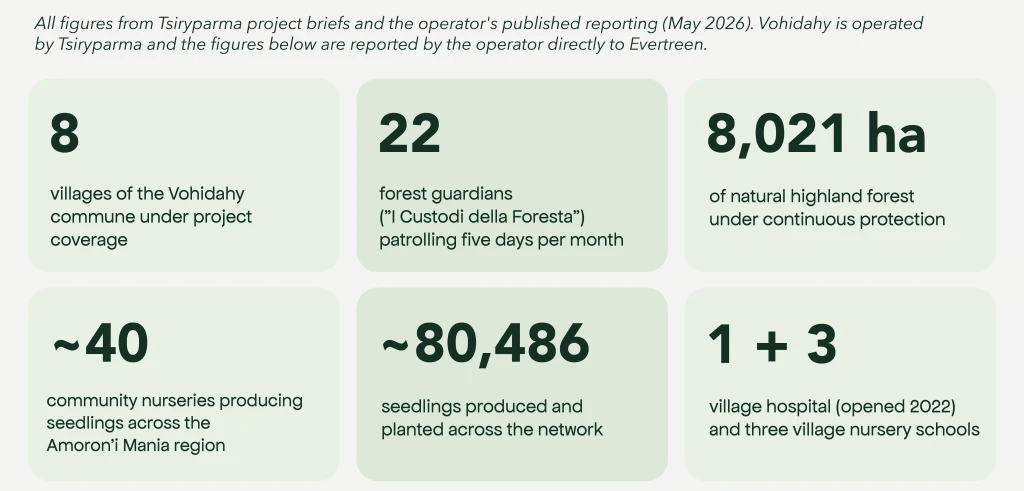
The Vohidahy Project, current totals:
- 8,021 hectares of natural forest guarded by the team
- 22 forest guardians drawn from the eight villages of the commune (6 leaders plus 16 village guardians)
- 80,486 seedlings produced across the Amoron'i Mania region since 2018
- 11,000 villagers in the Vohidahy commune (8 villages)
- 200 farmers in the organic vanilla program, hand-pollinating their crops each December
- ~40 nurseries run by Tsiryparma, split between the Vohidahy valley and the Ambositra countryside
Beyond the numbers: the project sponsors 22 children through the Caritas Children Sostegno a Distanza program, runs three Catholic nursery schools in the commune, maintains a base in the forest at Sahamapahy with demonstration sites for fish farming and coffee, supports the Ambohajanahary beekeeping cooperative producing eucalyptus honey on the road into Vohidahy, and harvests the endemic wild forest pepper tsiperyfery, which grows only in Madagascar.
The Forest Itself
Madagascar is often called the eighth continent. More than 5 percent of the world's species live on this single island, and roughly 70 percent of those species are found nowhere else. Vohidahy sits in the eastern highland forest zone of Madagascar. The block of forest the project protects is still under continuous canopy at around 1,000 metres of altitude, where the cultivated foothills give way to wet evergreen forest. The commune is also known regionally for its waterfalls, natural rock pools, caves, and the headwaters of the Mananjary River.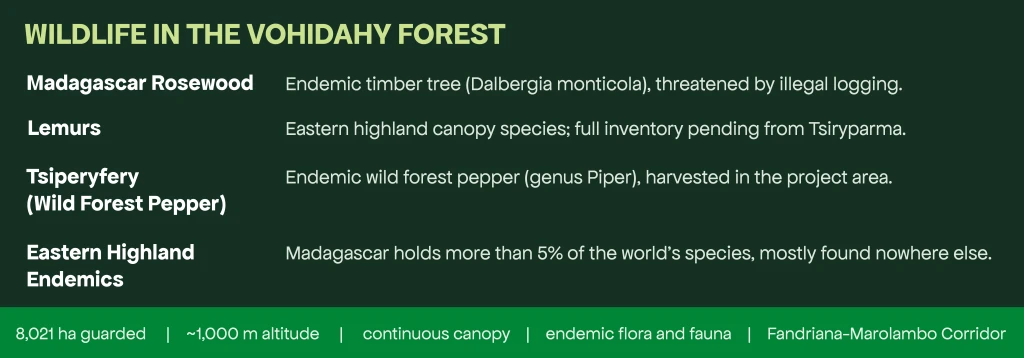 Dalbergia monticola, the species of Madagascar rosewood the project's lead researched for his university thesis on its ecology and sustainable management, is the headline endemic timber tree in this forest. The illegal trade in its dark, heavy wood is still active in the cities. Other named precious timber species under pressure here include varonghy, nato, kimba, and lalona. Lemurs remain in the canopy and are still hunted by some residents for meat. The wild forest pepper tsiperyfery, endemic to Madagascar and now used in European kitchens for its citrus and woody notes, grows in the same understory. The Vohidahy nursery, set up in 2008, was built around Dalbergia monticola as its core multiplication target, and the wider Tsiryparma nursery network propagates more than 20 species, from acacia and tephrosia for soil improvement to mango, citrus, avocado, baobab, neem, and moringa for farmer plots.
The project also sits within a wider partner network. The Italian conservation partner SEVA, whose collaboration with Tsiryparma began in 2019 around the documentary "La Nostra Foresta," has purchased close to 20 hectares of land in the Vohidahy commune with the explicit aim of restoring it to natural forest. The Ambositra Forestry Administration provides government oversight, with its agents joining the team's two larger missions each year. Caritas Children di Parma and the Italian Waldensian Church have been long-standing supporters of the schools and the hospital. The list of partners is published openly on Tsiryparma's website.
Run on the Ground in Vohidahy
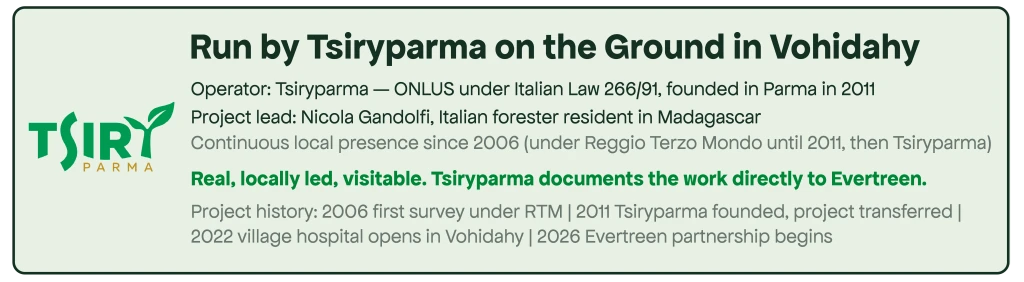
This is not a remote-managed project. Nicola Gandolfi, the Italian forester who leads the work, has worked in Madagascar since 2006 and lives there full-time today with his family. He started as a volunteer with the Italian NGO Reggio Terzo Mondo (RTM) and from 2011 onwards with Tsiryparma, the non-profit he co-founded in Parma to continue the forestry work after RTM stepped back from environmental programs. He holds two degrees (Natural Sciences from the University of Parma; Forestry and Environmental Sciences from the Politecnico delle Marche in Ancona) and his university thesis on the ecology of Dalbergia monticola was researched in Vohidahy in 2005 and 2006. He runs the project alongside a small team of Tsiryparma technicians, the village's own forest guardians, and the local women's association, and returns to Italy roughly once every two years.
Tsiryparma itself is an Italian volunteer non-profit, registered as an ONLUS under Italian Law 266/91. The project's track record is documented directly in monthly mission reports, photographs, video, and an open list of partner organisations on tsiryparma.org. There is no remote registry, no carbon methodology, and no third-party verifier attached to the Vohidahy Project. What there is, instead, is a continuous Tsiryparma presence in the village since 2011, building on a project line that started in 2006, backed by a documentation trail Tsiryparma shares directly with Evertreen.
 The project is visitable. Tsiryparma actively hosts Italian visitors travelling out to meet the team, and Evertreen partners are welcome to do the same. The work happens about 18 kilometres along a track that can only be reached by motorcycle from Tsararavina, in a valley where the time is set by the rainy season and the harvest.
Fund tree planting in Madagascar through Evertreen.
Frequently Asked Questions
Can I fund trees in Madagascar through Evertreen?
Yes. Evertreen offers tree planting in Madagascar, carried out by the Italian non-profit Tsiryparma. At Vohidahy, Tsiryparma also runs a community forest project covering 8,021 hectares of natural highland forest in the Amoron'i Mania region, alongside the eight villages of the Vohidahy commune.
How does Evertreen verify a small, locally run project like this one?
Vohidahy is not a Verra or ACR project, and we are direct about what that means. The credibility comes from Tsiryparma's documentation: monthly mission reports, photographs, video, an open list of partner organisations, and a continuous presence in the same village since Tsiryparma was founded in 2011, building on work in Vohidahy that started in 2006. The project lead has worked in Vohidahy since 2006 and lives in Madagascar full-time today. The project can be visited in person.
Can I gift trees linked to this project?
Yes. Evertreen gift certificates work for the Vohidahy Project as they do for any of our other projects. The recipient gets their own public tree page and follows the project's progress directly.
Does this project protect rare or endangered species?
The Vohidahy forest holds endemic species characteristic of Madagascar's eastern highland forest. Dalbergia monticola, the Madagascar rosewood, is the headline endemic timber tree. Lemurs remain in the canopy. The endemic wild forest pepper tsiperyfery (Piper borbonense) grows in the understory. Madagascar holds more than 200,000 species in total, with roughly 70 percent of them found nowhere else on Earth.
Is the Vohidahy Project a good option for corporate ESG and CSR reporting?
For ESG reporting that specifically requires a registry-certified carbon project, this work alone is not the right fit. For corporate giving, community impact reporting, or a credible local conservation story backed by a long-running, locally led, visitable project, it pairs well with the Verra-certified and ACR-certified projects in Evertreen's portfolio. Evertreen provides tracking, reporting tools, and a public impact page for your company.
Have more questions about how Evertreen works? Visit our FAQ.
Reviewed by Evertreen. Last updated: September 2026.
Sources: Tsiryparma project documents provided to Evertreen, including "I custodi della foresta," "Progetto filiera caffè per Vohidahy," and "Agricoltura sostenibile per l'empowerment delle donne a Vohidahy" (Associazione Miavotra), May 2026; Tsiryparma email correspondence from Nicola Gandolfi (15 February 2021) and Rita Magnini (12 February 2021); Tsiryparma plant species list and reforestation GPS coordinates; curriculum vitae of Nicola Gandolfi; additional context from the operator's website at https://www.tsiryparma.org. The Vohidahy Project is operated by Tsiryparma (ONLUS TsiryParma, an Italian volunteer association registered under Italian Law 266/91), with Nicola Gandolfi as project lead on the ground. Evertreen partners with Tsiryparma to bring the project to a wider audience and pass funding directly to the operator. Evertreen does not own or operate the project directly.
Support this project
